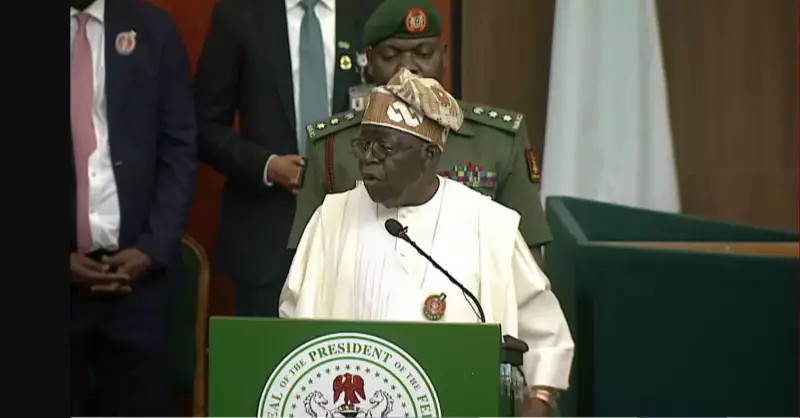
President Bola Ahmed Tinubu has declared that the year 2026 will usher in a stronger phase of economic growth for Nigeria, asserting that his administration's ongoing reforms are producing measurable results even amidst global economic challenges.
Economic Gains and Fiscal Plans for the New Year
In his New Year address to the nation, President Tinubu pointed to a robust economic performance in 2025. He stated that Nigeria recorded consistent gross domestic product growth across all quarters, with the annualised rate projected to surpass 4 per cent. The President highlighted a steady decline in inflation, which he said fell below 15 per cent, aligning with government targets.
Tinubu also noted significant improvements in external reserves and market performance. Foreign reserves stood at $45.4 billion as of December 29, 2025, providing a buffer for the national currency. Furthermore, the Nigerian Stock Exchange posted an impressive 48.12 per cent gain in 2025, continuing a bullish trend.

The President announced plans to consolidate these gains by deepening fiscal discipline and tax reforms. He aims to build a fairer and more sustainable revenue base. Tinubu commended states that have adopted harmonised tax laws to reduce the burden on citizens and businesses, pledging to confront the issue of multiple taxation across all government tiers.
Security Strategy and Social Investment Initiatives
On the security front, President Tinubu acknowledged persistent threats from criminal and terrorist groups. He revealed that decisive actions were taken against terrorist targets in the North-West on December 24, 2025, in collaboration with international partners including the United States.
For 2026, he promised that security and intelligence agencies would enhance cooperation with regional and global partners to eliminate national security threats. Tinubu reiterated his support for a decentralised policing system, complemented by regulated forest guards, as part of a broader strategy to tackle banditry and terrorism.
On social development, the President announced an acceleration of the Renewed Hope Ward Development Programme. The initiative aims to bring at least 10 million Nigerians into productive economic activity by empowering 1,000 people in each of the country's 8,809 wards, with a focus on agriculture, trade, and mining.
National Assembly Backs Reforms, Opposition Voices Dissent
The National Assembly has endorsed the government's trajectory, describing 2025 as a defining year. Senate Leader Opeyemi Bamidele stated that wide-ranging reforms in taxation, governance, and security had laid the groundwork for economic recovery in 2026. He highlighted the 2025 Tax Reforms Act, which takes effect from January 1, 2026, as a key legislative achievement aimed at harmonising the tax system and eliminating multiple taxation.
In stark contrast, the opposition African Democratic Congress (ADC) painted a grim picture of 2025. ADC National Chairman David Mark called it a year of widespread hardship, where the government's 'renewed hope' agenda translated into misery for citizens grappling with unaffordable food, medicine, and transport costs. Mark criticised new taxes, stating they would 'renew hopelessness' and renewed the party's call for opposition unity.
Former Vice President Atiku Abubakar echoed this criticism, labelling 2025 as 'one of the most punishing years in our recent history'. He blamed the ruling APC for economic hardship, political recklessness, and a governance style lacking in empathy. Atiku accused the administration of governing without a functional budget, reckless borrowing, and worsening insecurity marked by kidnappings and violent crimes.
As Nigeria steps into 2026, the nation stands at a crossroads defined by the government's promise of sustained recovery and the opposition's narrative of prolonged hardship, setting the stage for continued political and economic debate.