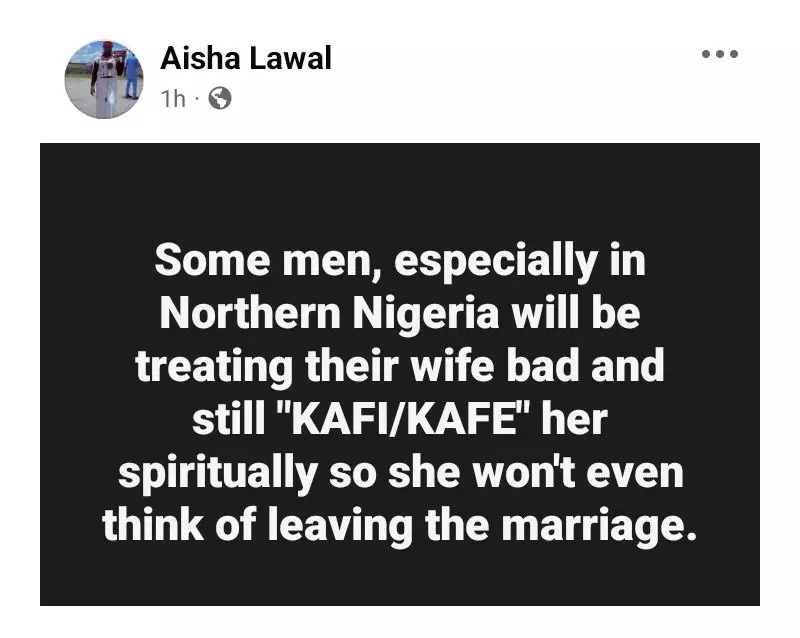
A Muslim woman has raised a serious alarm about the treatment of wives in some Northern Nigerian marriages, alleging a combination of maltreatment and spiritual manipulation to prevent them from leaving.
Aisha Lawal's Damning Allegation on Facebook
Aisha Lawal took to her Facebook page on Wednesday, January 7, 2026, to share her disturbing observations. She claimed that certain men, particularly in the Northern region of Nigeria, subject their wives to poor treatment. Beyond this, she accused them of employing spiritual means, locally referred to as "Kafi" or "Kafe," to bind their wives to the marriage.
"Some men, especially in Northern Nigeria will be treating their wives badly and still 'Kafi/Kafe' her spiritually so she won't even think of leaving the marriage," Lawal wrote in her post. Her statement highlights a dual layer of control: psychological and physical mistreatment coupled with alleged supernatural restraint.

Spiritual Bondage as a Tool for Irresponsibility
In her critique, Aisha Lawal directly linked the use of these spiritual methods to a character flaw in the husbands. She presented a clear cause-and-effect argument regarding marital stability.
"If you see a man going spiritual to tie his wife down not to leave him then be rest assured that he is irresponsible," she asserted. She contended that a husband's quality should be the natural anchor of a marriage. "If he is good, she will never want to leave," Lawal concluded, suggesting that resorting to spiritual coercion is an admission of failure as a partner.
Implications for Women's Rights and Marital Freedom
This public allegation opens a difficult conversation about women's rights within some marital contexts in Nigeria. It points to potential barriers to freedom that extend beyond social and economic factors into the realm of spiritual belief and fear.
The claim suggests that some women may feel trapped not only by societal pressure or lack of resources but also by an ingrained fear of spiritual consequences if they seek to exit an abusive union. This adds a complex dimension to the fight against domestic abuse and for gender equality in the region. Lawal's decision to speak out publicly encourages a necessary examination of these practices and their impact on the well-being and autonomy of married women.