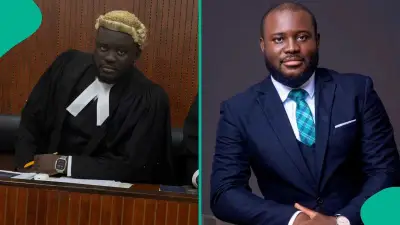
Presidency Alleges Forgery and Impersonation
Adeniyi Adeyemi Matthew is at the centre of a controversy involving an alleged fake government agency, a ₦1.3 billion budget allocation, and criminal charges of forgery and impersonation. The case has sparked widespread debate after budget documents showed an entity linked to him appeared in the 2026 Appropriation Act. The Presidency insists the agency never existed, while Adeyemi maintains his appointment was lawful.
The controversy centres on the Presidential Foreign Intervention Promotion Council (PFIPC), also referred to as the Presidential Economic Advisory Council (PEAC). Adeyemi presented himself as its Director-General, attending official meetings and receiving foreign delegations. However, the Presidency declared the PFIPC was never created by the Federal Government. In a statement, Special Adviser Bayo Onanuga alleged that Adeyemi forged an appointment letter purportedly signed by Chief of Staff Femi Gbajabiamila.
Arrest and Charges
Police investigations led to Adeyemi's arrest on October 27, 2025, at an office in the Federal Secretariat Complex, Abuja. According to the Presidency, investigators recovered forged appointment letters, fake letterheads, and other materials. Authorities also alleged he operated 34 bank accounts, including nine in the names of non-existent government entities. He allegedly opened an account with the Central Bank of Nigeria using forged documents, though no government funds were paid into it.

The Nigeria Police filed an eight-count charge against Adeyemi and two others, including conspiracy, forgery, and impersonation. The case is scheduled to continue on July 27, 2026.
Budget Allocation Raises Questions
The controversy deepened when an entity named Presidential Economic Advisory Council/Presidential Foreign Intervention Promotion Council appeared in the signed 2026 Appropriation Act with a total allocation of ₦1,302,978,784. This included ₦802.98 million for personnel, ₦200 million for overhead, and ₦300 million for capital expenditure. The discovery prompted public scrutiny, as the Presidency now describes the agency as fictitious.
Adeyemi has consistently denied the allegations. In interviews, he insisted his appointment was genuine and said he possesses a valid appointment letter, though he declined to make it public because the matter is in court. 'I am not a criminal. Let the court of competent jurisdiction vindicate me,' he said. He argued that he could not have openly met ministers and foreign diplomats if the council did not exist.
Counter-Allegations and Background
Adeyemi has levelled serious allegations against Femi Gbajabiamila, claiming the Chief of Staff demanded ₦27.4 billion (48% of the agency's proposed take-off grant) and that ₦400 million was paid through a proxy to facilitate his appointment, with another ₦200 million allegedly outstanding. The Presidency strongly denied those allegations, calling them false and an attempt to divert attention.
In a separate interview, Adeyemi claimed he had gone into hiding because he feared for his safety. 'They are now after my life. I have gone into hiding. I'm underground,' he said, though the claim has not been independently verified.
This is not the first time Adeyemi has attracted public attention. In 2016, he was reported to have emerged as President-General of the World Youth Organisation, which he claimed was affiliated with the United Nations. The UN later denied any affiliation. The Presidency cited this as part of a pattern of false representation.
Adeyemi has also stated he attended Anglican Grammar School, Igbara-Oke, studied at Ladoke Akintola University of Technology, and obtained a master's degree from the University of Western Ontario in Canada. However, these claims have not been independently verified.
The case remains before the Federal High Court, where prosecutors will seek to prove the allegations, while Adeyemi maintains he is the legitimate head of the council. Until the court delivers its judgment, the allegations against him remain unproven.