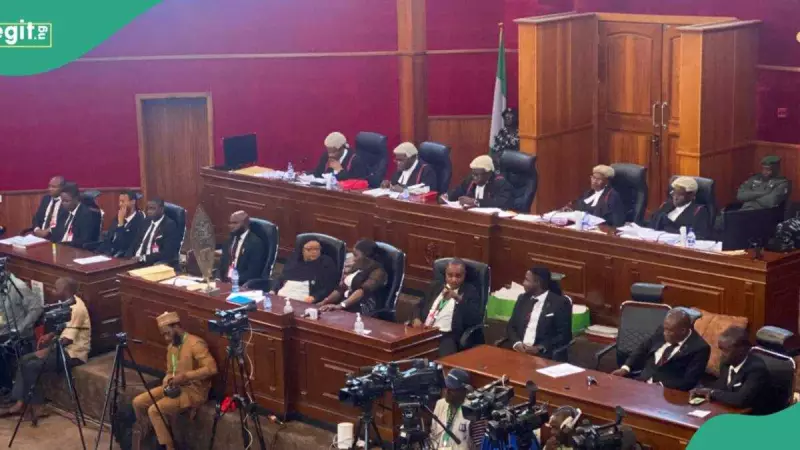
The Court of Appeal sitting in Kano has delivered a decisive verdict, dismissing the appeal filed by Abdulmalik Tanko and upholding the death sentence imposed on him for the kidnap and murder of five-year-old Hanifa Abubakar. The ruling, delivered on January 2, 2026, brings a significant chapter in a case that horrified the nation closer to a final resolution.
Appellate Court Affirms Lower Court's Judgment
Justice A. R. Muhammad, presiding over the appellate court, ruled that the initial judgment by the Kano State High Court was sound, lawful, and fully supported by the evidence presented during the trial. The court found no merit in the appeal lodged by Abdulmalik Muhammad Tanko, who was sentenced to death by hanging two years prior alongside his accomplice, Hashimu Isyaku.
The case dates back to December 2021, when Hanifa was abducted while returning home from her Islamiyya school. Tanko, who was the proprietor of the Northwest Preparatory School she attended, orchestrated the kidnapping. During the trial, it was revealed that he demanded a ransom from Hanifa's parents, motivated by his own financial debts. In a chilling confession, Tanko admitted to murdering the young girl after receiving an initial ransom payment, fearing she could identify him.

Public Reaction to the Judicial Decision
The news of the Appeal Court's decision has sparked widespread reactions across Nigeria. Many citizens have taken to social media to express their views on the ruling and the pace of justice.
Suleiman Abdullahi recalled the role of media intervention, stating, "I remembered how the case was brought to human rights radio stations in Abuja. The ordinary Ahmad Isah threw his weight into the case to make sure it wouldn't be put under the carpet. #Justice for Hanifah."
Meshach Agbo commended the judiciary while urging caution: "That means the Nigerian judicial system has taken a new dimension. Meanwhile, let's wait for the Supreme Court before we conclude."
Others, like Khaleel Muhammad Umar, expressed impatience with the legal process: "Why are people on death row left alive for so long? As soon as evidence is concluded and the sentence is passed, the execution shouldn't extend for 4 months. This has been years."
Abdulkadir Yusuf highlighted the case's potential as a deterrent: "The culprit cannot escape the gallows, despite, I knew he would try to exhaust all legal avenues. This case is supposed to serve as a deterrent to those who think they can easily get away free after committing a heinous crime without punishment."
The Path Forward and a Contrasting Pardon
While the appeal has been dismissed, the legal process may not be fully exhausted, as the possibility of an appeal to the Supreme Court remains. The case continues to be a focal point for discussions on justice, child safety, and the effectiveness of Nigeria's legal system in dealing with grievous crimes.
In a contrasting development reported earlier, the article referenced Adamawa State Governor Ahmadu Fintiri pardoning Sunday Jackson, a farmer who was on death row for killing a herdsman in self-defence during a farm attack. Jackson had spent over a decade in jail before his release, which occurred amidst international outcry over communal violence. This juxtaposition highlights the complex and often contentious nature of sentencing and clemency within the Nigerian justice system.