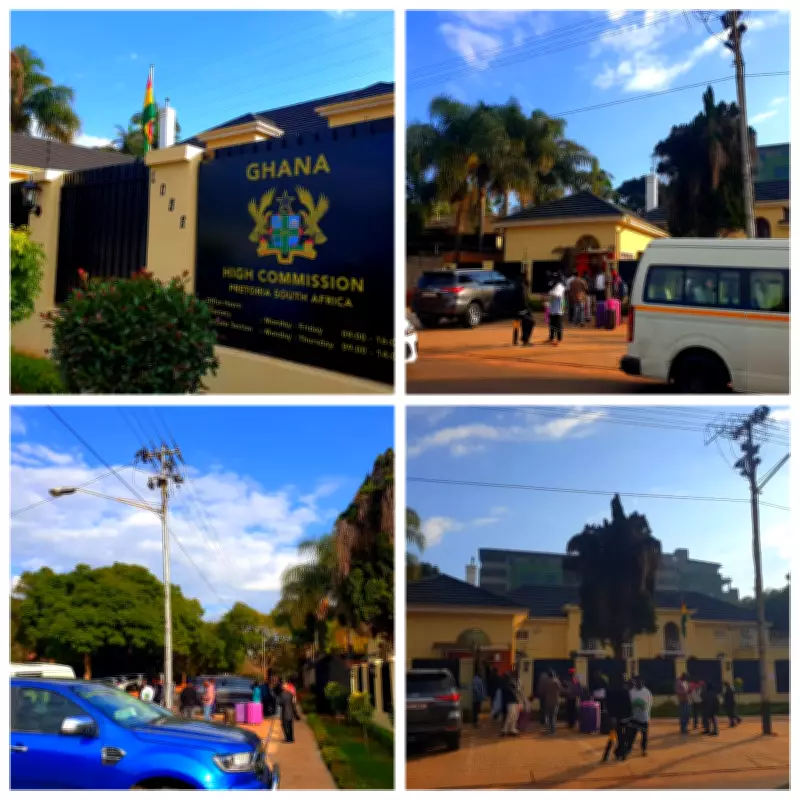
Scores of Ghanaian nationals turned up for the screening and verification process at the Ghanaian embassy in Pretoria on Sunday, May 24, 2026. This development follows the recent announcement by Ghana's High Commissioner to South Africa, Benjamin Quashie, that 826 Ghanaians had registered to be evacuated from the country.
Quashie revealed that the screening process for the first 300 Ghanaians, who are scheduled to depart on Wednesday, has been accelerated due to the recent anti-migration protests that have erupted across South Africa. These nationwide protests, led by the interest group “March and March,” have taken place in Gauteng, KwaZulu-Natal, and the Eastern Cape, with demonstrators demanding that non-South Africans leave the country by the end of June.
According to Quashie, there are currently over 16,000 Ghanaians residing in South Africa, the vast majority of whom are living legally and adhering to local laws. However, he emphasized that the climate of intimidation has forced many Ghanaians to consider returning home. “The Government of Ghana feels that it is time to bring those who feel unsafe in this country back home, to reintegrate them into Ghanaian society. We have 800 people who have volunteered to leave South Africa and have written their names. The first screening is for 300 people, a process we began today, which will continue into tomorrow, and then the first 300 will leave on Wednesday,” Quashie stated.

Commenting on the protests that have spread across Gauteng, KwaZulu-Natal, and the Eastern Cape, Quashie remarked: “I think we don't have to mince words in calling it xenophobic attacks. I believe that the things that have been happening across the country, where people take the law into their own hands, are a challenge. But I also believe that this will not put a strain on the diplomatic relationship between South Africa and Ghana. The only thing is that we should move from talking to action.”
One of the Ghanaians who showed up for the screening process, Fredrick, said he had come to South Africa seeking a better life. Although he had not personally experienced any danger, he described life in Johannesburg as a “risk.” “Even if you are not in danger from xenophobic attacks or riots, there are a lot of things. People can come into your house, point a gun at you, and rob you. Even in the streets, you are not safe,” he said. When asked if he would ever return to South Africa, Fredrick replied, “Never. I can never come back to South Africa.”
Another Ghanaian national, 22-year-old Sylvester Boakye, who last week became the only citizen to arrive at OR Tambo International Airport following a miscommunication over the date of the chartered flight to Ghana, shared his story. Boakye, who worked as a hairdresser for the past two years, revealed that his efforts to return home were thwarted by a lack of funds and numerous encounters with officials who would demand money from him. “When I missed my flight on my visit to South Africa, I could not raise enough money to go back home. A fellow Ghanaian tried to help me and gave me a job. I tried to raise enough money to return home, but things became too difficult as the little money I would make would be taken from me by corrupt officials, who always target us for bribes,” he stated.
Another Ghanaian resident, who did not wish to be named, said his ten-year stint in South Africa exposed him to numerous physical attacks, with the most recent occurring in Meadowlands, Soweto. “I was attacked by a group of guys in Meadowlands, who were speaking in the local language. Unfortunately, I could not speak their language. They then kicked me and beat me up. That is why I have run to the embassy because I want to go home,” he stated.