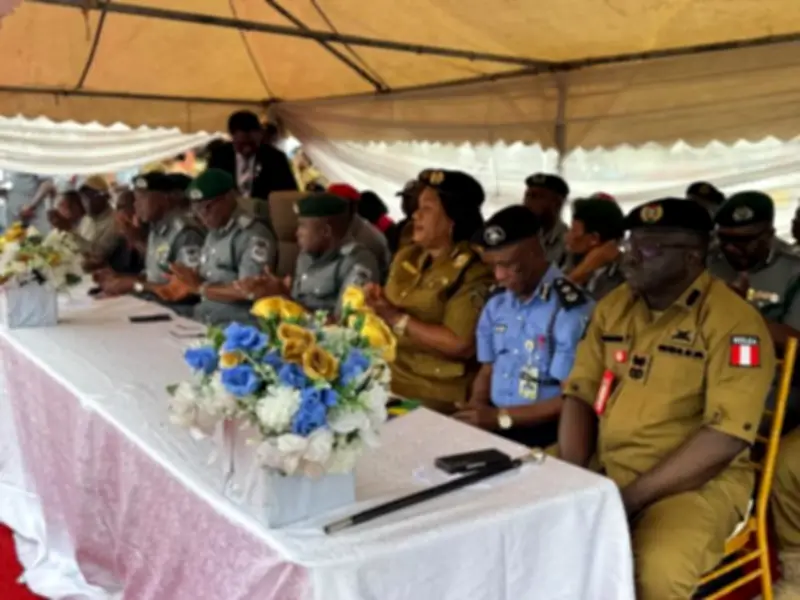
The National Drug Law Enforcement Agency (NDLEA) has formally taken custody of 6,778.5 kilograms of a high-potency cannabis strain known as “Canadian Loud,” intercepted in two containers at the Apapa seaport in Lagos. The seizure was the result of a joint operation involving the Nigeria Customs Service and other security agencies.
Handover ceremony at Apapa Port
The handover ceremony took place on Wednesday, July 1, at the port. NDLEA Chairman, Brig. Gen. Mohamed Marwa (Rtd), represented by the agency’s Director of Seaport Operations, ACGN Ibinabo Archie-Abia, described the seizure as a landmark demonstration of inter-agency cooperation. Marwa stated that the drugs were recovered in two separate seizures on 15 and 24 June.
Intelligence-led operation
Marwa explained that the seizures followed months of intelligence-led tracking by the NDLEA’s Special Investigation Unit and Marine Intelligence Unit, working in collaboration with the Royal Canadian Mounted Police (RCMP) and Nigeria Customs. Operatives identified that traffickers were routing shipments through complex, multi-continent maritime routes to evade detection.

Details of the shipments
Providing a breakdown of the shipments’ movement, Marwa said the first container, CAAU 7569127, left Toronto on 16 April, was moved by rail to Montreal, then shipped via Tangier Med in Morocco before arriving at Tin Can Island Port on 27 May and finally being intercepted at Apapa on 10 June. The second container, HAMU 3246311, left Montreal on 1 May, was trans-shipped through Algeciras, discharged at Tin Can Island on 4 June, and moved to Apapa on 22 June, where it was intercepted.
Commitment to prosecute traffickers
Marwa emphasized that the agency’s work would not end with confiscation. He vowed to pursue the financial structures behind the syndicates so that traffickers “derive no benefit whatsoever” from the trade, and to identify, arrest, and prosecute those responsible. He commended the professionalism of NDLEA, Customs, and other security personnel involved, describing the operation as proof of what intelligence-driven, cross-border collaboration can achieve against transnational organised crime.