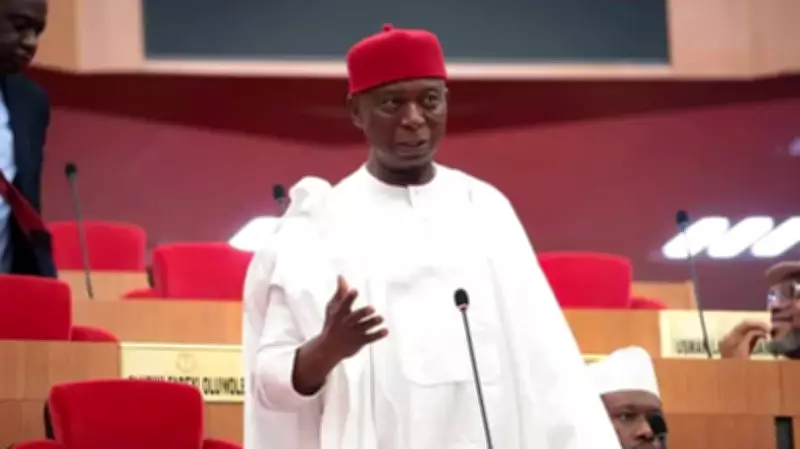
Senator Ned Nwoko has firmly rejected claims that his firm has been fully paid the outstanding $396 million tied to the Paris Club debt consultancy, insisting the sum remains unpaid more than a decade after the court judgment. Nwoko, who represents Delta North in the National Assembly, was responding to allegations by self-styled whistleblower George Uboh, who recently petitioned the Federal Government and the Economic and Financial Crimes Commission (EFCC), urging them to halt further payments on the grounds that the obligation had already been settled.
Nwoko's Response to Allegations
In a statement issued Wednesday by his media office in Abuja, the senator described Uboh’s allegations as “malicious, unfounded, and dishonest,” accusing him of a pattern of blackmail and extortion. “Contrary to these false claims, the outstanding balance of $396 million due to my company has not been paid,” Nwoko said. “This matter has undergone multiple investigations by the EFCC in 2018, 2019, 2020, and 2024, none of which invalidated the debt.” He added that official records from the anti-graft agency support his position. “The EFCC has a full history of my payments. The records are there,” he stressed.
Context and Allegations
Providing further context, Nwoko claimed that Uboh had previously acknowledged the unpaid status of the consultancy fees. He cited a July 7, 2014 report allegedly submitted by Uboh to the Nigeria Governors’ Forum, recommending payment of the agreed 20 percent consultancy fee to his firm. “He knows that the money approved for my company was diverted,” Nwoko said, alleging that Uboh himself received $48 million from the NGF for what he described as a brief consultancy report. The senator also referenced a May 20, 2020 WhatsApp message purportedly sent by Uboh, which he said confirmed that the funds remained outstanding—an apparent contradiction of the whistleblower’s current claims.

Legal Action and Background
Nwoko further alleged that Uboh demanded $13 million from him and $19 million from the Federal Government under the guise of whistleblowing. He disclosed that legal action is already underway over what he described as a forged document allegedly used by Uboh to claim entitlement to fees, including the falsification of a lawyer’s seal. “If I had agreed to pay him, would he have taken this action or gone to court?” Nwoko queried. He urged the public to disregard what he called deliberate misinformation, reiterating his commitment to resolving the matter through lawful and transparent means. The dispute traces back to 2013 when Nwoko, through his company, was engaged as a consultant representing the 774 local government councils, the six area councils of the Federal Capital Territory, and the Association of Local Governments of Nigeria (ALGON) in a suit against the Federal Government. The case sought the recovery of $3.188 billion allegedly deducted from local government allocations to service Nigeria’s Paris Club debt. On December 3, 2013, the Federal High Court in Abuja ruled in favour of the plaintiffs, ordering a full refund and approving a 20 percent consultancy fee—amounting to $637.6 million—for Nwoko’s firm. Subsequent enforcement led to a garnishee order absolute against the Central Bank of Nigeria in June 2016, a decision later upheld by the Court of Appeal in February 2018.