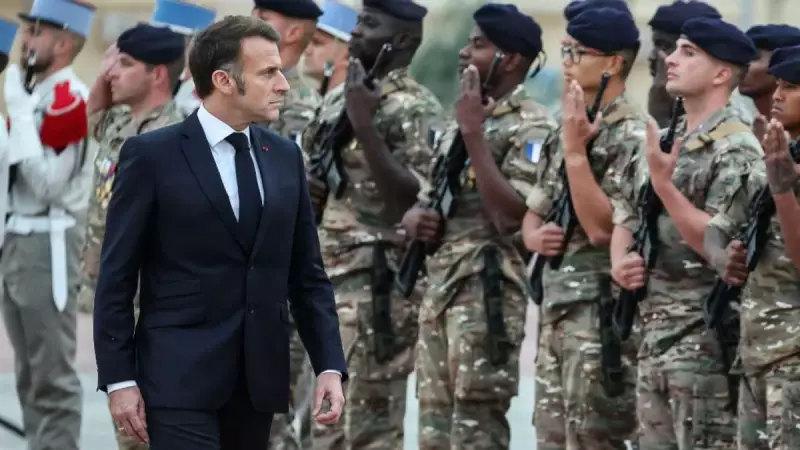
French President Emmanuel Macron has officially authorised the construction of a new nuclear-powered aircraft carrier, a major military project intended to replace the country's current flagship, the Charles de Gaulle. The announcement was made on Sunday, December 21, 2025, during Macron's traditional Christmas visit to French troops stationed in the United Arab Emirates.
A Strategic Decision for a "Predatory" Age
Speaking to military personnel, President Macron framed the decision as a crucial step for France's global standing. "In an age of predators, we must be strong in order to be feared," he stated. The final approval for the project was granted earlier in the week, following a comprehensive review aligned with recent French military programming laws.
This move comes despite ongoing budgetary constraints within France, the European Union's second-largest economy. The official launch will enable the government to sign all necessary contracts for the ambitious build. The project has faced domestic criticism, with figures like military chief General Fabien Mandon questioning whether resources should be directed to more immediate priorities, especially amid concerns about a potential European conflict with Russia.

Specifications of the Future Flagship
The new carrier will represent a significant upgrade in size and capability over the Charles de Gaulle, which entered service in 2001 and is the only nuclear-powered carrier outside the United States Navy.
The future vessel's key specifications include:
- A displacement of nearly 80,000 tons, compared to the Charles de Gaulle's 42,000 tons.
- A length of approximately 310 metres, making it notably longer than the current 261-metre carrier.
- The capacity to carry a crew of 2,000 sailors and operate about 30 fighter jets.
While still smaller than the U.S. Navy's supercarriers, which displace over 100,000 tons, the new French carrier will be comparable in size to those operated by China and the United Kingdom, though it will retain the advantage of nuclear propulsion.
UAE Visit Focuses on Security and Partnership
President Macron's trip to the Gulf state served a dual purpose: celebrating the year-end holidays with over 900 deployed French troops and strengthening bilateral ties. A key discussion point was enhanced cooperation in combating international drug trafficking.
Macron met with Emirati President Mohamed bin Zayed Al Nahyan, later posting on social media platform X that they discussed fortifying their strategic partnership, particularly for "stability in the Middle East." The UAE is a major client for French defence equipment, and reports suggest Paris may seek Abu Dhabi's involvement to salvage a troubled future fighter jet programme with Germany.
The French delegation included Justice Minister Gerald Darmanin, who has previously urged the UAE to extradite around 15 suspected drug traffickers wanted by France. Major traffickers are believed to have found refuge in the UAE, especially Dubai, where some have invested heavily in real estate.
The decision to proceed with the carrier, first studied in 2018 with preliminary work starting in 2020, signals France's long-term commitment to maintaining a powerful, independent blue-water navy capable of projecting force globally.