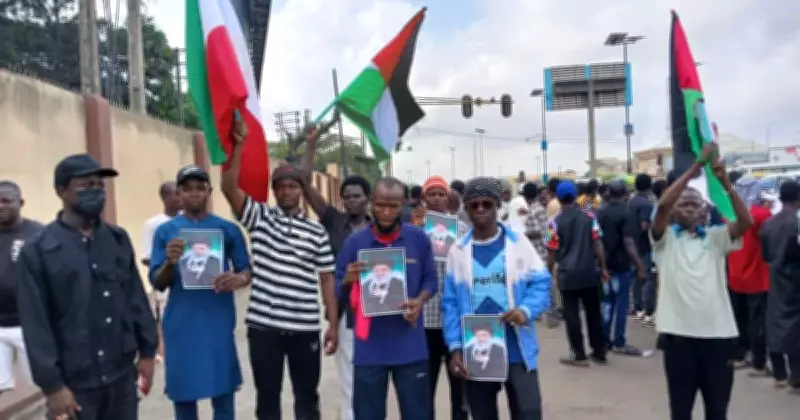
Nationwide Protests Erupt in Nigeria Following Reported U.S.-Israel Strike on Iran
Widespread demonstrations have broken out across eight Nigerian states as members of the Islamic Movement of Nigeria (IMN) protest against the reported assassination of Iran's Supreme Leader, Ali Khamenei, in a joint military action attributed to the United States and Israel. The protests have raised significant security concerns and highlighted how international events resonate within Nigeria's Muslim community.
Protests Span From Lagos to Northern States
Protests were recorded in Lagos, Kano, Niger, Sokoto, Gombe, Kaduna, Bauchi, and Yobe states, demonstrating the nationwide reach of the movement. In Lagos, demonstrators marched through the Maryland area carrying banners and placards that condemned what they described as an "invasion" of Iran and a targeted assassination of the Iranian leader.
Similar gatherings occurred in northern Nigeria, particularly in Kano and Kaduna where the IMN maintains a significant following. Protesters expressed solidarity with Iran and openly criticized both the United States and Israel for the military operation.

Security Forces on High Alert
Security presence was visible along protest routes, with the Lagos State Police Command stationing officers at key locations to prevent disruptions to law and order. The Acting Inspector General of Police, Olatunji Disu, has ordered state police commissioners to be on red alert to prevent worsening internal security challenges.
Disu specifically directed police commissioners in the Northwest, Northeast, and Northcentral zones to:
- Heighten surveillance and intelligence gathering
- Strengthen collaboration with traditional and religious leaders
- Enhance visibility policing around worship centers and public spaces
No official casualty figures have been confirmed from the protests at the time of reporting.
Understanding the Islamic Movement of Nigeria
The Islamic Movement of Nigeria is a prohibited Shia religious group founded by Ibrahim Zakzaky that seeks to establish an Islamic state in Nigeria. The movement draws inspiration from the Iranian Revolution and does not recognize the legitimacy of the Nigerian government.
Based at the spiritual center Husainiyya Baqiyatullah in Zaria, the IMN emphasizes peaceful strategies to establish an Islamic state and has gained some recognition as an alternative government. Membership is estimated at about 5% of Nigeria's Muslim population of 100 million.
Background on Iran's Supreme Leader
Ali Hosseini Khamenei served as Iran's second Supreme Leader since 1989, succeeding Ruhollah Khomeini. Before assuming this position, he was Iran's president from 1981 to 1989. As Supreme Leader, he was the highest authority in the Islamic Republic, overseeing the country's armed forces, judiciary, and key state institutions.
Protest Motivations and International Context
Muftau Zakariya, the South West coordinator of IMN, explained that the rally aimed to highlight concerns about what they perceive as ongoing invasions of sovereign countries by the U.S. administration. Zakariya referenced recent events in Venezuela, including the invasion and takeover of the nation's president and energy systems.
He stated that intensified activities in Kwara state follow U.S. engagement in the nation's matters, suggesting a pattern of international interference that the IMN opposes.
Broader Implications for Nigerian Security
The development has heightened political tension beyond Iran's borders and demonstrated how Middle Eastern events continue to resonate within sections of Nigeria's Muslim community, particularly among Shi'ite groups. While there has been no official statement from Nigerian federal authorities at the time of reporting, the protests signal potential security challenges that require careful management.
The nationwide nature of the protests underscores the organizational capacity of the IMN and their ability to mobilize supporters across multiple states simultaneously. This presents ongoing challenges for Nigerian security forces who must balance maintaining public order with respecting the right to peaceful protest.