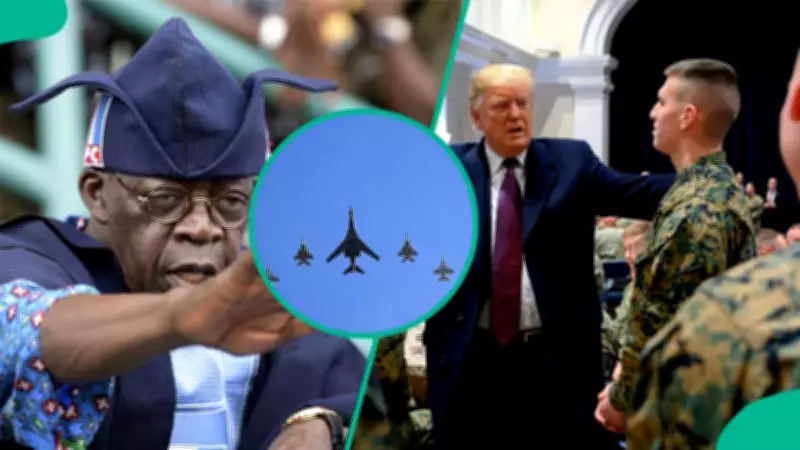
Enhanced Nigeria-US Military Cooperation Details Surface After Trump's CPC Designation
Specific details regarding the strengthened military collaboration between Nigeria and the United States have now emerged, following increased coordination efforts that were initiated after former US President Donald Trump re-designated Nigeria as a Country of Particular Concern (CPC) in October of last year. This significant diplomatic move occurred amidst persistent allegations of Christian persecution within Nigeria, claims that the federal government has consistently and firmly denied.
High-Level Diplomatic Engagements and Strategic Agreements
The re-designation prompted a series of high-level diplomatic exchanges. Former President Trump had previously made strong statements, including threats to deploy US troops into Nigeria with aggressive force to eliminate terrorists targeting Christian communities. In response to these developments, President Bola Tinubu dispatched a high-level delegation led by National Security Adviser Nuhu Ribadu to engage with US Defence Secretary Pete Hegseth.
A source familiar with the discussions revealed, "Hegseth provided assurances that the Department of Defense is working aggressively with Nigeria to combat terrorism, although the precise details of the engagement framework were not fully disclosed during those initial meetings."

Operational Implementation: Intelligence Flights and Precision Strikes
Shortly after these diplomatic talks, operational collaboration commenced. The United States initiated intelligence-gathering flights over Nigerian territory, utilizing contractor-operated aircraft that originated from Accra, Ghana. This intelligence sharing culminated in tangible military action on Christmas Day, when the US launched precision strikes targeting two terrorist enclaves located in the Bauni Forest within Tangaza Local Government Area of Sokoto State.
The Nigerian Ministry of Foreign Affairs officially confirmed these operations, stating that the "precision hits" were executed as a direct result of intelligence sharing and strategic coordination conducted under established international and bilateral agreements. Residents in communities across Sokoto and Kwara states reported hearing explosions, which were later identified as debris resulting from precision-guided munitions fired by US forces.
Logistical Support and Advisory Team Deployment
Further details from officials indicate that the United States formally requested the establishment of a refueling station within Nigeria to support drone operations following missions launched from Ghana. Initial suggestions included locations in Lagos or Abuja, but the Federal Government counter-proposed a station in a north-eastern state that already hosts Nigeria's domestic drone operations, aiming to enhance logistical efficiency and coordination.
An official emphasized the non-combat nature of the engagement, stating, "We are not going to have boots on the ground. Their support will focus on equipment provision, intelligence sharing, and advisory capacity, including specialized training initiatives. This is fundamentally not a combat operation."
General Dagvin Anderson, the head of US Africa Command (AFRICOM), publicly confirmed the deployment of a "small advisory team" to Nigeria, which generated considerable public interest and discussion. A knowledgeable source clarified to media outlets that "AFRICOM has maintained ongoing collaboration with Nigeria for some time. US military personnel have been present, but the specific scope of their assignment has now evolved to more directly support intelligence and training initiatives."
Nigeria's Minister of Defence, Christopher Musa, provided additional context, explaining that the deployed personnel are not combat troops but rather a specialized advisory team assisting with intelligence gathering and training programs. Officials noted that this team played a crucial role in coordinating the Christmas Day precision strikes in Sokoto State.

Recent High-Level Military Diplomacy
This development follows a recent visit by Commander AFRICOM, General Dagvin Anderson, to President Bola Ahmed Tinubu and serving Nigerian service chiefs at the State House in Abuja. The AFRICOM delegation, which included Charge D'Affairs of the US Embassy in Nigeria Keith Heffern, Senior Foreign Policy Adviser Amb. Peter Vrooman, and Command Sergeant Major Garric M. Banfield, met with President Tinubu on Sunday, 8 February 2026, underscoring the ongoing strategic dialogue between the two nations.
The emerging framework of Nigeria-US military cooperation represents a significant evolution in bilateral security relations, characterized by enhanced intelligence sharing, precision strike capabilities, and advisory support, all while maintaining the principle of Nigerian-led ground operations against terrorist threats.