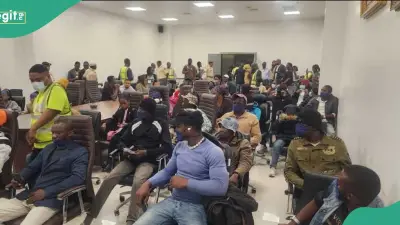
The Federal Government has placed 33 states and the Federal Capital Territory (FCT) on high flood alert for 2026, warning that 14,118 communities across 266 local government areas (LGAs) face a high risk of flooding. The warning was issued by the Minister of Water Resources and Sanitation, Joseph Utsev, during the public presentation of the 2026 Annual Flood Outlook (AFO) by the Nigeria Hydrological Services Agency (NIHSA) at the State Banquet Hall, Presidential Villa, Abuja, on April 15.
High-risk zones identified
According to the minister, the high-risk states include Abia, Adamawa, Anambra, Bauchi, Bayelsa, Benue, Borno, Cross River, Delta, Ebonyi, Edo, Enugu, Gombe, Imo, Jigawa, Kaduna, Kano, Kebbi, Kogi, Kwara, Lagos, Nasarawa, Niger, Ogun, Ondo, Osun, Oyo, Plateau, Rivers, Sokoto, Taraba, Yobe, Zamfara, and the FCT. “Fourteen thousand, one hundred and eighteen communities in 266 local government areas in 33 States and the FCT fall within the high flood risk areas,” Utsev stated.
Moderate and minimal flood risks
Beyond the high-risk areas, the outlook identified 405 LGAs in 35 states as moderate flood-risk zones. The report noted that every state except Ekiti falls within the moderate flood risk category. Additionally, minimal flooding is projected for 923 communities across 77 LGAs in 24 states. The states for minimal flood risk are Adamawa, Anambra, Bauchi, Bayelsa, Benue, Borno, Cross River, Delta, Ebonyi, Edo, Jigawa, Kaduna, Kano, Kebbi, Kogi, Nasarawa, Niger, Ogun, Ondo, Osun, Oyo, Sokoto, Taraba, and Zamfara.

Community-based forecasting system
Minister Utsev introduced an upgraded, community-based flood forecasting system powered by hybrid AI models. This system provides specific local alerts rather than broad state-level generalizations, allowing authorities to issue flood predictions for individual communities. The approach is expected to improve preparedness and enable quicker emergency response when flood threats arise.
Presidential commitment to disaster response
President Bola Tinubu reaffirmed his administration's commitment to improving Nigeria's emergency response systems. Represented by the Minister of Environment, Balarabe Lawal, the President said the government had assessed existing challenges and recognized the need to strengthen rescue operations. He stressed the importance of sustainable development, better planning, and stronger communication among government agencies and the public to enhance disaster preparedness and response.
Recurring flood crisis
Flooding has become one of Nigeria's most recurring natural disasters, especially during the peak of the rainy season. Heavy rainfall, overflowing rivers, poor drainage systems, and rapid urbanization have contributed to widespread flooding, destroying homes, farms, and critical infrastructure. In response to warnings from NEMA and NIHSA, state emergency management agencies are rapidly clearing clogged drainage paths and establishing emergency response centers to mitigate seasonal displacement.
The 2026 Annual Flood Outlook was presented under the theme: "Smart Water Resources Management: Moving From Oil To A Water-Based Economy," with ministers, government officials, and stakeholders from the water resources sector in attendance.