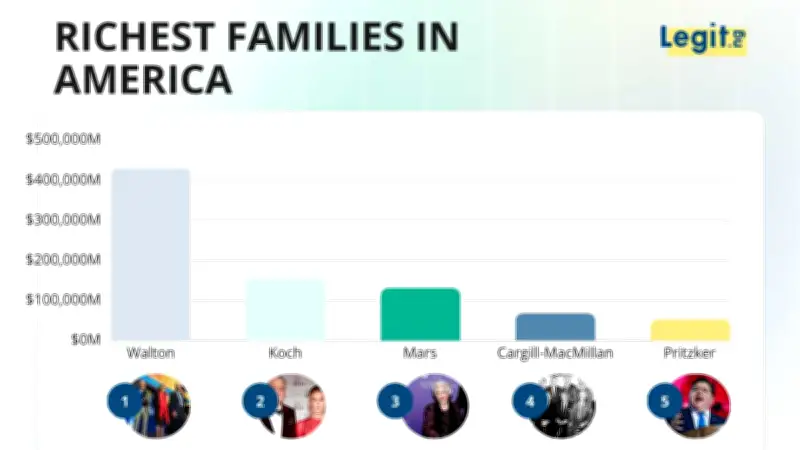
The Walton family is the richest in America with a combined fortune exceeding $430 billion, anchored by their controlling stake in Walmart. This wealth is more than the next several families on the list combined. From century-old oil dynasties and candy empires to a chicken sandwich chain that refuses to open on Sundays, these 15 families represent the ultimate in multigenerational American wealth.
Ranking of America's 15 Richest Families
The rankings are based on data from Forbes' America's Richest Families 2026 list and the Bloomberg Billionaires Index, including combined family net worth, controlling stakes in public and private companies, and verified individual fortune estimates. The most up-to-date figures available as of July 2026 were used. Forbes' definitive ranking of the 54 richest multi-generational families excludes individual billionaires credited with the entire family fortune on the World's Billionaires list; estimated fortunes were calculated using stock prices from June 22, 2026.
15. Rockefeller Family (~$11 Billion)
The Rockefellers are the quintessential American "old money" dynasty. Their wealth has endured for six generations, with a net worth of over $11 billion. While they no longer control Standard Oil, the Rockefeller descendants remain among America's wealthiest through extensive investment portfolios, trusts, philanthropy, and real estate holdings. John D. Rockefeller's 19th-century Standard Oil monopoly was broken up by the Supreme Court in 1911, but the dispersed shares only made the family richer.

14. Hearst Family (~$21.8 Billion)
The descendants of media baron William Randolph Hearst are worth an estimated $21.8 billion. Hearst, the inspiration behind Orson Welles' Citizen Kane, owned 28 major newspapers and 18 magazines at his peak. Today, Hearst Corp. owns hundreds of newspapers and magazines worldwide and has investments in cable TV channels such as ESPN, Lifetime, and A&E.
13. Newhouse Family (~$30 Billion)
The Newhouses inherited Advance Publications, which owns Condé Nast Publications—responsible for Vogue, The New Yorker, Vanity Fair, and other publications—and has stakes in Discovery Communications and Reddit. Samuel Irving Newhouse began the business in 1922. Donald Newhouse remains owner and shares the title of co-president with his son Steven.
12. Lauder Family (~$33 Billion)
The Lauder dynasty came into its money through cosmetics firm Estée Lauder, founded in 1946. Estée Lauder Companies includes 29 brands, among them MAC and Clinique. Three generations have shaped global beauty standards. The family's combined net worth now exceeds $33 billion.
11. Edward C. Johnson Family (~$36 Billion)
In 1946, Edward C. Johnson II founded Fidelity Management & Research Company. Today, the privately owned company is managed by his granddaughter, Abigail Johnson. Under Abigail's stewardship, Fidelity has grown into one of the world's largest asset managers, overseeing trillions in assets under management.
10. Cox Family (~$38 Billion)
The Cox family closes the top 10 with $38 billion. Cox Enterprises is one of America's largest privately held companies, operating Cox Communications (broadband and cable), Cox Automotive (Autotrader, Kelley Blue Book, Manheim), and dozens of media properties. The fortune now spans broadband, automotive data, and media.
9. S.C. Johnson Family (~$39 Billion)
Samuel Curtis Johnson founded SC Johnson in 1886. Now in its fifth generation of family ownership, SC Johnson has evolved into a global household products giant with hundreds of brands sold in more than 70 countries, including Glade and Ziploc. The company's annual revenues exceed $10 billion.
8. Cathy Family (~$40.2 Billion) — The Chicken Family
The Cathy family amassed $40.2 billion through Chick-fil-A. Truett Cathy founded the chain in an Atlanta-area mall in 1967, and it now operates more than 3,000 restaurants across 48 states. The company's well-known policy of closing on Sundays is rooted in the family's Christian faith. Chick-fil-A is also expanding overseas, with plans to open locations in Europe and Asia by 2026.

7. Duncan Family (~$43 Billion)
The Duncan family accumulated $43 billion through energy infrastructure and pipelines. Texas native Dan Duncan founded Enterprise Products in 1968. His four children inherited the firm; Randa Duncan Williams serves as chairman. The company had an annual turnover of $34 billion when Duncan died in 2010.
6. Pritzker Family (~$53.2 Billion)
The Pritzkers appear with $53.2 billion. Jay Pritzker, along with his brothers Robert and Donald and their father A.N. Pritzker, created Hyatt and invested in Marmon Group. J.B. Pritzker serves as Governor of Illinois, while Tom Pritzker chairs Hyatt Hotels Corporation, which operates more than 1,300 hotels globally.
5. Cargill-MacMillan Family (~$67.9 Billion)
The Cargill-MacMillan family holds $67.9 billion. The family boasts eight billionaires and a total of 90 members who own 88% of Cargill Inc., founded in Iowa in 1865. Cargill is one of the biggest private companies in America, with annual revenue of around $177 billion.
4. Mars Family (~$120–141 Billion)
The Mars family ranks among the wealthiest families in the world, with approximately $141 billion in collective net worth. Mars, Incorporated is the world's largest confectionery company and a dominant player in pet care, with brands including M&M's, Snickers, Pedigree, Royal Canin, and Wrigley. The company generates over $50 billion in annual revenue. In 2025, Mars acquired snack company Kellanova for $35.9 billion, adding the Pringles brand.
3. Koch Family (~$155 Billion)
Charles Koch has been chairman of Koch, Inc., America's second-largest private company by revenue, since 1967. The diversified company has some $125 billion in revenues from businesses including pipelines, chemicals, software, and Dixie cups. David's widow Julia Koch inherited his 42% stake upon his death in 2019, making her one of the richest women in America.
2. Mars Family Honorable Mention — No. The Waltons Take the Crown
1. Walton Family ($430+ Billion)
The Waltons are the richest family in America thanks to their stake in Walmart, which became the first brick-and-mortar retailer to boast a $1 trillion market cap in February 2026. Walmart founder Sam Walton gave his kids 80% of his Walmart stake decades before it became a multibillion-dollar business. Heirs include Sam's three living children—Rob, Jim, and Alice Walton—and others. Jim Walton has a net worth of $152 billion, Rob Walton $149 billion, and Alice Walton $148 billion. The company claims 90% of Americans live within 10 miles of a Walmart or Sam's Club location.
Frequently Asked Questions
Are the Rothschilds the richest family in the world?
No. Excluding royal dynasties, the Rothschild family became the richest in the mid-19th century, but their wealth has been divided among many descendants. Today, the Walton family is the world's richest family by any credible measure.
Does the Walton family still own Walmart?
Yes. An estimated 41% of Walmart's stock is held by the families of seven heirs of Sam Walton and his brother Bud. Charitable trusts in the name of Sam's son John Walton are estimated to own another 6%.
Is Elon Musk richer than the Walton family?
Not as a family unit. Five members of the Walton family have a combined net worth of $453 billion—greater than Elon Musk's $425 billion. As an individual, Musk holds one of the largest personal fortunes, but the Walton family collectively outpaces him.
What does the Koch family own?
Koch, Inc. is a sprawling conglomerate with annual revenues exceeding $125 billion and interests in refining, pipelines, chemicals, fertilizers, commodities, paper products, electronics, and software.
How many billionaires are in the Mars family, and what do they own?
The Mars family is known for its privacy. John Mars and Jacqueline Mars each own 1/3 of the company. Frank's great-granddaughters Victoria, Pamela, Valerie, and Marijke own the remaining 1/3. The business is the world's largest candy maker, best known for Snickers, Milky Way, and Twix. With its purchase of Wrigley in 2008, it commands more than half of the US chewing-gum market.