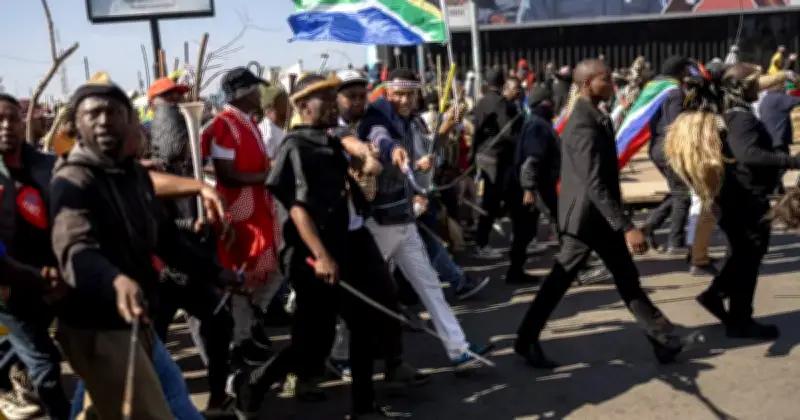
South Africa has deployed security forces nationwide as anti-immigrant groups enforce an unofficial June 30 deadline for undocumented migrants, raising fears of xenophobic violence. Thousands of police officers and other security personnel have been stationed in major cities and potential flashpoints, with the government warning that violence, intimidation, and attacks on foreign nationals will not be tolerated.
Massive Security Deployment Ahead of Protests
Police Minister Firoz Cachalia announced that thousands of officers have been deployed to major cities to crack down on any violence or vigilante action. He stated, "Crime, intimidation, violence, destruction of property and any attempt to undermine public safety will not be tolerated." President Cyril Ramaphosa also reassured citizens and foreign nationals that security agencies are on high alert and prepared to deal with any unrest. The government has stressed that immigration concerns must be handled through legal processes rather than vigilante action.
Thousands of Migrants Await Repatriation
The growing uncertainty has forced thousands of migrants to seek ways out of South Africa. Large groups, mostly from Malawi and Zimbabwe, have gathered in Johannesburg and Cape Town while waiting for transport back to their home countries. Many report being forced from their homes after landlords asked them to leave or losing their jobs because employers feared becoming targets of anti-immigrant groups. Several African governments have arranged buses and chartered flights to repatriate their citizens ahead of the June 30 deadline, reflecting the seriousness of the situation.

Groups Behind the June 30 Deadline
The campaign is driven by organizations including Operation Dudula and the March & March movement, which argue that undocumented migration contributes to unemployment, crime, and pressure on public services. Operation Dudula, whose Zulu name translates to "push back" or "force out," has previously organized demonstrations outside businesses owned by foreign nationals and stopped people in public to demand identification documents. Another prominent figure is Nkosikhona Ndabandaba, known as "Phakel'umthakathi," who has over 1.7 million Facebook followers. Speaking to CNN, Ndabandaba claimed he was the architect of the deadline. In a widely shared video, he tells a Congolese man to leave South Africa without asking about his legal status, saying, "June 30 is the deadline, but you don't have to wait until then – leave now. I can't control the people of South Africa."
History of Xenophobic Violence in South Africa
South Africa has experienced repeated outbreaks of xenophobic violence over the past two decades, often targeting migrants from Zimbabwe, Mozambique, Malawi, Nigeria, Somalia, and the Democratic Republic of Congo. The deadliest attacks occurred in 2008, when at least 62 people were killed and tens of thousands displaced in nationwide riots targeting foreign nationals. Since then, similar outbreaks have occurred periodically, prompting concerns from human rights organizations, neighboring governments, and the African Union. Authorities have urged residents to remain calm and warned that anyone responsible for attacks, looting, or intimidation will face arrest as security forces continue monitoring demonstrations across the country.