Iran's Revolutionary Guard Corps Issues Direct Threat to U.S. Technology Giants in Middle East
In a significant escalation of regional tensions, Iran's Islamic Revolutionary Guard Corps (IRGC) has issued a stark warning that it will target United States technology companies operating across the Middle East. The IRGC-affiliated Tasnim news agency released an official statement on Tuesday that explicitly listed approximately twenty American corporations that would now be considered "legitimate military targets" in any future conflict operations.
Major Technology Firms Named as Potential Targets
The comprehensive list of threatened companies includes some of the world's most prominent technology and manufacturing giants: Boeing, Tesla, Meta Platforms, Hewlett-Packard (HP), Microsoft, Google, and Apple. According to the IRGC statement, these institutions have been designated as targets because "the main element in designing and tracking terrorist targets are American and ICT and AI companies." The statement further declared that "from now on, these main institutions will be our legitimate targets."
Immediate Evacuation Orders and Attack Timeline
The Iranian military has urgently called for employees of these companies and residents living in proximity to their facilities to evacuate immediately. Officials have specified that coordinated attacks against these technology installations are scheduled to commence from 8:00 PM local time on Wednesday, but only if additional Iranian leaders are killed in what they describe as "targeted assassinations" by opposing forces.

Background of Escalating Regional Conflict
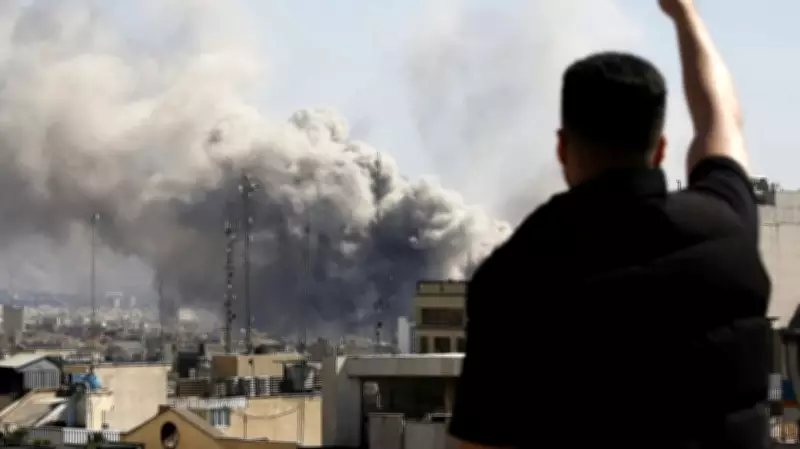
This latest threat follows Israel's announcement that its military has conducted more than 230 separate strikes across Iranian territory within the previous twenty-four hours. Israeli defense officials characterize these operations as part of a systematic campaign designed to degrade Iran's military capabilities significantly. Iran has repeatedly accused both Israel and the United States of deliberately targeting civilian infrastructure in previous engagements.
The Islamic Republic had previously threatened to target American and Israeli academic institutions throughout the region following recent air strikes against the Isfahan University of Technology and Tehran's Iran University of Science and Technology. These educational facilities suffered substantial damage during the attacks, which Iran claims violated international norms regarding civilian protection.
African Development Bank Warns of Economic Consequences
As the tripartite conflict between the United States, Iran, and Israel enters its fifth consecutive week with no diplomatic resolution in sight, the African Development Bank (AfDB) has issued a sobering economic warning. Bank economists project that the ongoing conflict's fallout poses significant downside risks to Africa's economic growth trajectory, with the continent potentially losing up to 1.5 percentage points in total economic output if the crisis persists beyond six months.
Detailed Economic Projections and Analysis
Speaking during the formal launch of the 2026 Africa's Macroeconomic Performance and Outlook (MEO) report, AfDB's Chief Economist Kelvin Urama provided detailed analysis of the potential economic impacts. While acknowledging that immediate effects might appear moderate initially, Urama emphasized that prolonged disruptions could substantially deepen existing economic vulnerabilities across African nations.
According to Urama's projections, the extent of economic shock would depend primarily on the conflict's duration. He specifically warned that extended periods of instability in the Middle East could significantly undermine Africa's fragile post-pandemic recovery. "If the war continues for up to six months, we might see about a 1.5 per cent decline in economic growth," Urama stated, adding that growth could still decrease by 0.2 percentage points even if the conflict is contained within three months.
Broader Economic Context and Outlook
The AfDB report notes that Africa's economic outlook already faces considerable pressure from multiple sources:

- Weak foreign direct investment inflows
- Declining official development assistance
- Tightening global financial conditions
These factors have collectively compounded the continent's exposure to external shocks like the Middle East conflict. Despite these substantial headwinds, the bank has maintained its growth projections at 4.3 percent for 2026 and 4.5 percent for 2027, reflecting a cautious optimism anchored on demonstrated resilience in several key economic sectors.