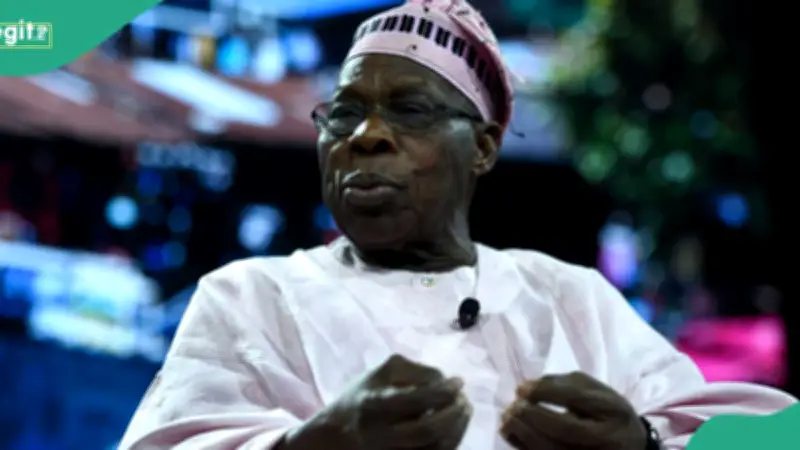
Former President Olusegun Obasanjo has cautioned that Nigeria must do everything possible to avoid a second civil war, stating that several of the underlying causes of the 1967–1970 conflict remain present in the country's institutions and among its people. Obasanjo made the remarks on Wednesday at the Olusegun Obasanjo Presidential Library (OOPL) in Abeokuta, Ogun State, during the presentation of a historical documentation on the Asaba Massacre by Chief Chuck Nduka-Eze, the Isama Ajie of Asaba.
Obasanjo on the Asaba Massacre
Speaking at the event, Obasanjo, who served as a military commander during the civil war, acknowledged that he had long avoided giving detailed accounts of the Asaba Massacre because that territory fell under the command of the late General Murtala Muhammed. He commended Nduka-Eze for undertaking the documentation, describing it as a contribution to preserving national history. "I must confess, and you know that I was involved in the civil war. When people talk about the Asaba Massacre, I always confess that I cannot give details of it," he said.
The former president also recalled personally intervening during the war to stop a soldier from raping a woman in Asaba, noting that command responsibility would have applied had he not acted. Obasanjo quoted former Head of State General Yakubu Gowon to underscore the gravity of his warning: "We will not survive a second civil war as a country."

Warning Against a Second Civil War
"I believe we have fought one civil war too many already. So, to say that we will have a second civil war, God forbid," Obasanjo said. "Thank you very much for making people know about it, for people to learn about it, and for people to take a vow that it should never happen again. I say to you, never."
The work, titled Asaba Massacre, is a two-part record comprising a published transcript and an audiovisual documentary drawn from eyewitness accounts, recorded interviews, archival materials and historical scholarship.
What the Asaba Massacre Documentation Found
Presenting his work, Nduka-Eze said the evidence gathered consistently showed that after federal troops entered Asaba during the civil war, civilians were gathered in public spaces and instructed to declare loyalty to Nigeria by chanting "One Nigeria." Men were then separated from women and children, and unarmed male civilians were subsequently killed despite having complied with the instructions. "The evidence establishes a recurring pattern. Civilians were assembled in public places under conditions of fear and uncertainty," Nduka-Eze said.
He stated that while a precise death toll could not be conclusively established, available evidence pointed to more than 1,000 civilian deaths, describing the incident as a devastating tragedy for the Asaba community. Nduka-Eze also echoed Obasanjo's concerns, warning that ethnic mistrust and suspicion among Nigeria's diverse groups, conditions that contributed to the civil war, remain largely unresolved.
Gowon Reflects on Civil War
Previously, Legit.ng reported that former Nigerian Head of State, General Yakubu Gowon (rtd), described the Nigerian civil war as the most challenging chapter of his life, reaffirming that his decisions during the conflict were borne out of national duty rather than animosity. Speaking at the Abuja Anglican Diocese's Christian Men’s Fellowship convention on Saturday, the 89-year-old statesman recounted the personal toll of leading Nigeria through the war that spanned from July 6, 1967, to January 15, 1970.