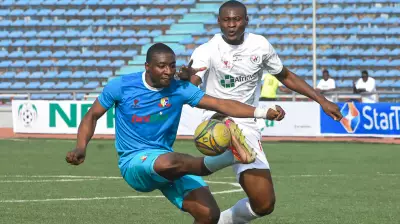
The Nigeria Football Federation (NFF) has firmly denied widespread media reports claiming that FIFA has dismissed its formal protest regarding the eligibility of certain Democratic Republic of Congo players. The federation insists its case remains under active review by world football's governing body.
Official Communication Awaited from FIFA
Reacting to the speculation, the NFF Secretary General, Dr Mohammed Sanusi, clarified that the body has received no official decision from FIFA. He made this statement during an interview on the African Independent Television (AIT) network. Sanusi challenged the sources of the reports, asking them to produce the alleged dismissal letter from FIFA.
"The Nigeria Football Federation wrote a petition to FIFA on the eligibility of some of the players of DR Congo, and if there is anything, FIFA will reply to the NFF," Sanusi stated. "The NFF has not received any letter from FIFA saying they have thrown away our petition. We have checked our emails, and there was no letter from FIFA."

The Core of Nigeria's Eligibility Argument
The controversy stems from the 2026 World Cup African play-off final in November, where the Super Eagles lost 4-3 on penalties to DR Congo after a 1-1 draw. The NFF's petition argues that several Congolese players, including Aaron Wan-Bissaka and Axel Tuanzebe, were ineligible to feature.
The federation's position hinges on a dual claim: a breach of FIFA regulations and a violation of Congolese national law. Sanusi has previously asserted that "FIFA was deceived into clearing them," pointing out that Congolese law does not permit dual citizenship, while some of the players in question hold European passports.
The NFF maintains it has submitted comprehensive documents and legal arguments to FIFA to support its claim of what it describes as a "fraudulent" breach of the rules.
Reactions and Potential Consequences
The Congolese Football Federation (Fecofa) has vehemently rejected Nigeria's petition. In a public response, Fecofa characterized the move as an attempt by "bad losers" to overturn a sporting result through "lawyer tricks." They advised Nigeria to "play the World Cup with dignity and confidence."
Under FIFA statutes, the outcome of this case could have significant sporting implications. The governing body has several options:
- Dismiss the case for insufficient evidence.
- Open an investigation leading to administrative sanctions like fines or warnings.
- In serious cases with clear evidence of rule breaches, impose sporting sanctions.
Such sporting sanctions could include forfeiture of the match, which would award a 3-0 victory to Nigeria, potentially reviving the Super Eagles' chances of progressing to the intercontinental play-offs for the 2026 World Cup. Precedents exist, such as South Africa being deducted points in the 2026 qualifiers for fielding a suspended player.
The NFF continues to await FIFA's final determination on the matter, which holds the key to Nigeria's hopes for the tournament to be hosted by Canada, Mexico, and the United States.