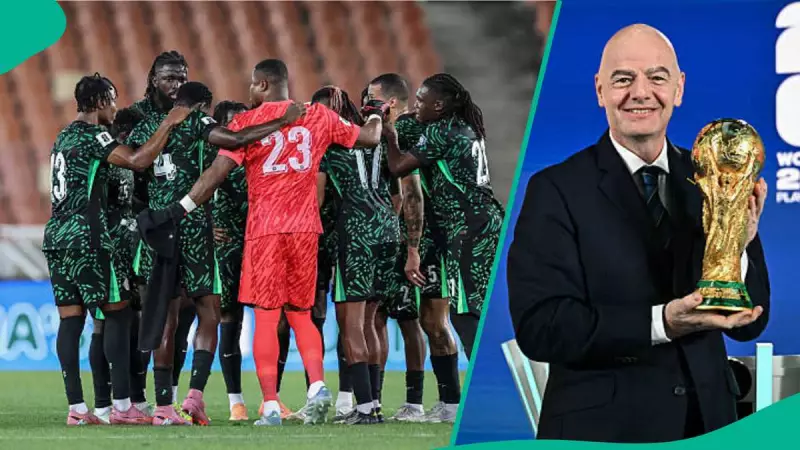
The Nigeria Football Federation (NFF) has launched a formal petition to FIFA that could dramatically alter the landscape of African qualification for the 2026 World Cup. This move comes after the Super Eagles' heartbreaking exit last month, following a penalty shootout defeat to DR Congo.
The Core of Nigeria's FIFA Petition
At the heart of the controversy is the NFF's allegation that DR Congo fielded multiple ineligible players during the crucial playoff final. Nigeria's hopes were dashed in November 2025 after a 1-1 draw led to a 4-3 penalty shootout loss, which sent the Leopards to the inter-confederation playoffs scheduled for March 2026.
However, the NFF, led by General Secretary Mohammed Sanusi, contends that the victory was illegitimate. The federation argues that between six and nine Congolese players did not fully comply with their own country's domestic laws regarding nationality before representing the national team.

Sanusi has been explicit in his claims, stating that Congolese law does not permit dual nationality. He alleges that several players involved in the match still held European passports—including French and Dutch documents—at the time of their selection. Furthermore, the NFF has raised eyebrows over the administrative process, suggesting some players obtained clearance suspiciously fast, within a mere three months.
The Legal Battle: FIFA Rules vs. Domestic Law
This case presents a complex clash between international sporting regulations and domestic legal frameworks. Under FIFA's statutes, a player's eligibility is primarily contingent on holding a valid passport for the country they wish to represent. FIFA does not enforce the internal nationality laws of its member associations.
Sanusi acknowledges this distinction, noting that FIFA initially cleared the players based on the documentation presented. However, Nigeria's argument hinges on an accusation of fraudulent misrepresentation. The NFF's position is that FIFA was deceived because the governing body was not made aware that the players' participation violated the Democratic Republic of the Congo's own legal codes.
"FIFA goes by its own regulations. But our contention is that FIFA was deceived into clearing them because the regulations of Congo were not abided by. We are saying it was fraudulent," Sanusi explained.
Potential Outcomes and Reactions
If FIFA's investigation, which is currently underway according to ESPN, rules in Nigeria's favour, the consequences would be seismic. The most likely outcome would see the Super Eagles replace DR Congo in the next stage of qualification. Nigeria would then advance to Group K of the inter-confederation playoffs, facing Portugal, Uzbekistan, and Colombia, with just one victory needed to secure a spot at the 2026 World Cup.
The Federation of Congolese Football Associations (FECOFA) has vehemently dismissed Nigeria's claims. In a strong rebuttal, Congolese officials branded Nigeria as "sore losers" who failed to qualify on the pitch and are now attempting to use legal technicalities to gain entry through the "back door."
The football world now awaits FIFA's decision, which is expected before the inter-confederation playoffs begin in March 2026. This off-field drama adds a new chapter to a rivalry that was already intensified by post-match comments from Nigeria's head coach, Eric Chelle, who had accused DR Congo players of unconventional practices during the penalty shootout.