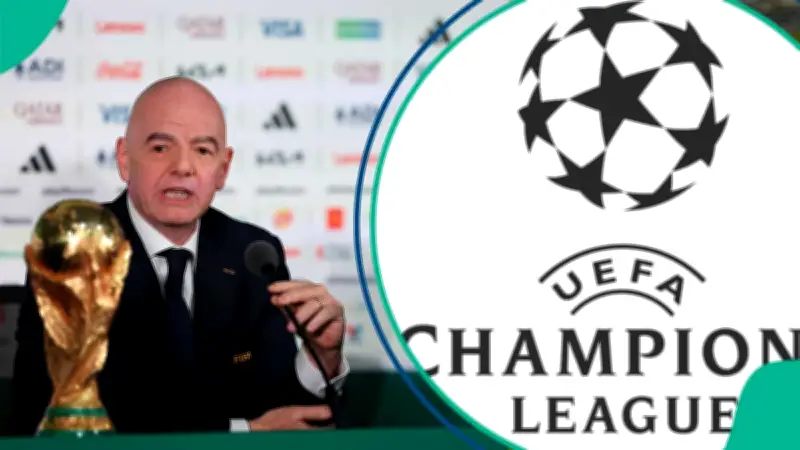
UEFA has confirmed that it will not adopt FIFA's controversial red card rule that punishes players for covering their mouths while speaking to opponents during confrontations, opting instead for a more flexible disciplinary approach across its club competitions next season. The decision means players competing in the UEFA Champions League, Europa League and Conference League will avoid automatic dismissals for the offence introduced during the ongoing FIFA World Cup.
Instead, referees have been instructed to treat the action as unsporting behaviour, with offenders liable to receive a yellow card while disciplinary bodies retain the authority to investigate incidents further if necessary. The announcement represents one of UEFA's most significant decisions ahead of the new campaign, especially after the controversial law sparked widespread debate following its implementation at the World Cup.
UEFA opts against automatic red cards
In a statement released on Thursday reported by the BBC, UEFA confirmed that it would not activate the option of applying the new IFAB law across its competitions despite having the authority to do so. Under UEFA's guidance, match officials are expected to use their judgment rather than automatically dismiss players who attempt to hide conversations by covering their mouths. The governing body explained that the behaviour could still be punished if referees consider it unsporting.

"This is obviously without prejudice to any disciplinary investigation or proceedings that may follow as a consequence of or in connection with such behaviour," the statement said. UEFA also informed its member associations that referees should rely on discretion when handling such incidents instead of applying an automatic sending-off. Its guidance added that players attempting to conceal communication as an act of unsporting behaviour should receive a yellow card.
FIFA introduced tougher punishment at World Cup
The controversial rule was introduced for the 2026 FIFA World Cup following concerns over players attempting to conceal abusive or discriminatory comments during heated exchanges. According to the New York Times, FIFA president Gianni Infantino was among the strongest advocates for the tougher punishment, insisting the measure would help combat offensive behaviour on the pitch. "If a player covers his mouth and says something, and this has a racist consequence, then he has to be sent off, obviously," Infantino said in March.
Following those discussions, the International Football Association Board (IFAB) held an extraordinary meeting where members agreed to classify the action of covering the mouth during confrontations as a straight red-card offence. FIFA's refereeing chief, Pierluigi Collina, later clarified that the law was never intended to punish ordinary conversations between players. "If it is a friendly conversation, they can continue to do it without any problem," Collina explained. "When it is confrontational, it is a completely different story. Covering the mouth means you are doing something potentially very wrong. This is something you do on purpose. It is not something that a player can do instinctively."
Rule already produced controversial dismissals
The new regulation has already generated headlines during the World Cup. Paraguay midfielder Miguel Almirón became the first player to receive a straight red card under the law after covering his mouth while confronting an opponent. Ecuador defender Piero Hincapié was also dismissed for committing the same offence during the tournament. England midfielder Jude Bellingham, however, escaped punishment after officials reportedly concluded that although he briefly covered his mouth while speaking to a Ghana player, the exchange was not viewed as confrontational.

The debate surrounding concealed conversations intensified earlier this year after a Champions League fixture between Benfica and Real Madrid. During the match, Benfica youngster Gianluca Prestianni covered his mouth with his shirt while speaking to Real Madrid winger Vinícius Júnior. The Brazilian later accused the player of racist abuse, but UEFA's subsequent investigation concluded that Prestianni was instead guilty of anti-gay conduct, resulting in a six-match suspension. That incident became one of the key examples cited during discussions about strengthening regulations surrounding hidden verbal exchanges between players.
UEFA adopts expanded VAR powers
Although UEFA rejected FIFA's stricter disciplinary measure, the BBC added that the European governing body confirmed it would embrace another major change introduced during the World Cup. Video assistant referees will now have authority to review incorrectly awarded corner kicks, allowing officials to overturn corner decisions and instead award goal kicks when appropriate. The technology has already played a notable role during the World Cup, where more than 20 incorrectly awarded corners were overturned following VAR intervention. UEFA believes the additional review process will improve decision-making without significantly disrupting the flow of matches.