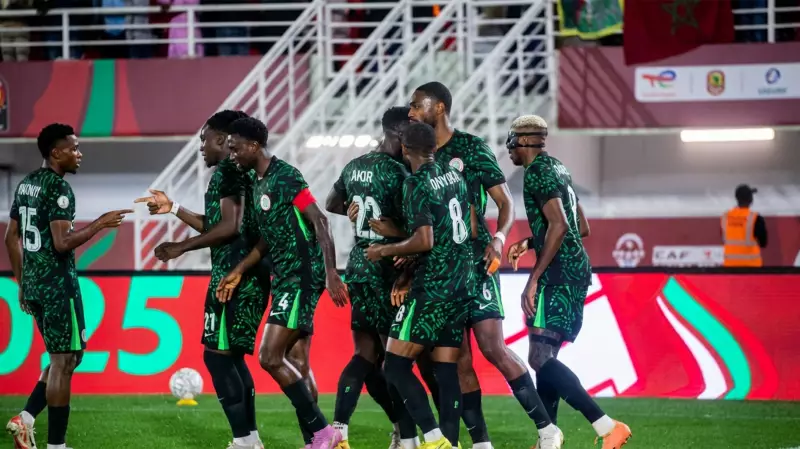
Nigeria's Super Eagles delivered a commanding performance on Tuesday, 6th January 2026, securing a dominant 4-0 victory over Mozambique to advance to the Africa Cup of Nations (AFCON) quarter-finals. Yet, the nation's conversation swiftly pivoted from celebration to controversy, centering on a heated on-field exchange between star forwards Victor Osimhen and Ademola Lookman.
The Incident That Stole the Headlines
During the Round of 16 clash, with Nigeria comfortably leading 3-0 in the 63rd minute, a moment of friction erupted. Victor Osimhen, poised for a potential hat-trick, was visibly furious when Ademola Lookman opted not to pass the ball to him in a promising attacking position. Osimhen's reaction was intense, involving loud shouts and animated gestures directed at his teammate, requiring intervention from captain Wilfred Ndidi and even a Mozambican player.
The Napoli striker's frustration did not subside there. He subsequently asked to be substituted and was seen sitting apart from the squad, completing a picture of visible discontent that quickly became the main talking point for Nigerian fans and media, despite the comprehensive win.

National Reaction vs. Team Reality
The public and official response to Osimhen's outburst was swift and severe. A government official publicly criticized the player, labeling him a man of "big talent, but poor character." Social media and traditional punditry circles were ablaze, conducting a full-scale inquisition into team spirit and leadership, often assuming the dressing room was in crisis.
However, the key voices from within the camp told a different story. Ademola Lookman, the apparent target of Osimhen's ire, downplayed the incident after the match. "I don't really think that's really important, the team won 4-0," he stated, referring to Osimhen as "our number one guy" and "my brother." Captain Wilfred Ndidi framed the spat as a manifestation of a "competitive mindset" among elite athletes. Their comments suggested the issue was already resolved internally, a stark contrast to the external frenzy.
Nigeria's Historical Fear of Hidden Division
This national obsession with internal conflict is not without context. It is rooted in a deep-seated, generational trauma from past Nigerian teams where discord was silent and corrosive. Many recall the legendary 1994 squad, where issues of ostracization, not public arguments, are believed to have undermined team cohesion at a critical juncture.
This history makes the nation pathologically sensitive to any sign of division. In a paradoxical way, Osimhen's very public display of frustration is almost more manageable than whispered grievances; it is a problem out in the open that the coaching staff can address directly. The debate has become about preferring a messy, public catharsis over a silent, smiling poison.
Focusing on the Pitch, Not the Drama
Lost in the noise are the undeniable facts of the match and the players' professional relationship. Lookman provided two assists for Osimhen during the same game, and the duo have shared numerous goal celebrations together throughout their time with the national team. This functional reality on the pitch outweighs a momentary lapse in temper.
Former internationals like Mutiu Adepoju have wisely urged focus on the team's "dominant, improving form." The lesson from those who have worn the green and white jersey is clear: the primary objective is to win football matches. Internal issues should be resolved behind closed doors, and the pursuit of the AFCON trophy should be the only discourse that truly matters.
While Victor Osimhen must undoubtedly apologize to the squad and learn to channel his formidable passion more wisely, Nigeria as a football-loving nation must also mature. The Super Eagles have just delivered their most convincing performance in recent years. Instead of relentlessly searching for cracks, perhaps the support should now be on steering the team toward the title. Their job is to win. Ours, for once, should be to let them.