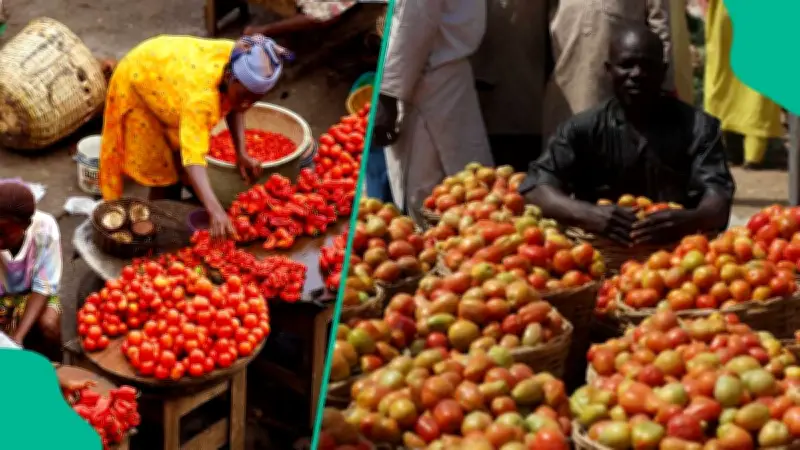
Tomato prices have surged across Nigerian markets, more than doubling in some cases within three weeks, prompting consumers to cut back on purchases and turn to alternative ingredients for their meals. The price spike has intensified the strain on household budgets amid rising food inflation.
Price Surge at Major Markets
A market survey conducted at Mile 12 International Market in Lagos revealed that a large basket of Jos tomatoes, which sold for between N60,000 and N70,000 in May 2026, now costs between N120,000 and N150,000. Similarly, the price of a crate has climbed from about N25,000 to N70,000. The National Bureau of Statistics (NBS) reported that food inflation increased from 16.68% in April 2026 to 16.96% in May 2026, reflecting broader price pressures.
Consumers Adapt with Alternatives
Many households have altered their cooking habits. Mrs Susan said tomatoes have nearly disappeared from her family's weekly meals. “We now use vegetables, carrot and cabbage sauce and even palm kernel stew. The last vegetable sauce I made was as black as the back of a pot because I used very little tomato,” she explained. Mrs Ebele noted that a paint bucket of tomatoes that once cost N4,000 now sells for N10,000 in her area. “I buy only half the quantity and mix it with vegetables so it can go round my family,” she said.

Foodstuff retailer Madam Jerome observed that many customers now buy tomatoes only out of necessity. “I bought a basket equivalent to three paint containers for N40,000. Many people prefer this type because of its plumpness and colour. Tomatoes are gold in the market now,” she said. She also recounted losing money after purchasing a basket of Jos tomatoes for N120,000, only to find that many fruits beneath the top layer were unripe and partially spoiled.
Farmers Blame Processing Industry Decline
Farmers attribute the recurring price instability to the collapse of industrial off-take arrangements and the shutdown of major tomato processing companies across the country. According to them, the disappearance of large-scale buyers has weakened demand for locally produced tomatoes, discouraged farmers from expanding production, increased market uncertainty, and ultimately contributed to higher consumer prices.
Tomato trader Ibrahim Aminu blamed poor farming conditions in northern Nigeria. “Arewa are not farming well due to rainfall and drought on the farm,” he said. Despite Nigeria being Africa's second-largest tomato producer after Egypt, with an estimated annual output of between 1.8 million and 2.3 million metric tonnes, the commodity continues to experience sharp price fluctuations.
Regional Differences in Tomato Quality
The survey also found that tomatoes produced in the South-West have become more common in the market because they are cheaper. However, many traders and buyers complained that this variety contains more water and yields less paste than northern-grown tomatoes. Consumer Blessing said her family still prefers tomatoes from the North because they produce thicker and richer tomato paste.
The persistent rise in tomato prices has exacerbated food inflation in Nigeria, with consumers increasingly turning to alternative ingredients to manage their budgets.