The Nigerian telecommunications industry is poised for a transformative year in 2026, pivoting from a phase of consolidation to one of aggressive expansion. This acceleration will be powered by a dual strategy focusing on a massive fibre optic backbone rollout and the integration of advanced satellite connectivity, aiming to bridge the nation's persistent digital divide.
The Foundation: From Consolidation to Accelerated Growth
The year 2025 was marked by industry consolidation and resilience amidst significant quality of service complaints. However, 2026 is widely anticipated to be a year of accelerated growth. This optimism is shared by industry bodies like the Association of Licensed Telecom Operators of Nigeria (ALTON) and the Association of Telecommunication Companies of Nigeria (ATCON), who point to rising digital demand, sustained investment, and improved regulatory alignment as key drivers.
Despite missing the 70% broadband penetration target set for December 2025—achieving only 50.58% by November—data consumption hit a major milestone. Nigerians consumed 1.24 million terabytes of data by November 2025, according to the Nigerian Communications Commission (NCC), with a significant leap expected from December's festive online activities.

Deolu Ogunbanjo, President of the National Association of Telecom Subscribers of Nigeria (NATCOM), acknowledged that telephone services were subpar in 2025 but expressed optimism for 2026 based on anticipated investments in fibre, satellite, hyperscale data centres, and AI infrastructure.
The Fibre Revolution: Building a $2 Billion Digital Backbone
The centrepiece of 2026's expansion is the accelerated rollout of the $2 billion Building Resilient Digital Infrastructure for Growth (BRIDGE) Project. Described by ATCON President Tony Emoekpere as a major confidence booster, this initiative aims to create a non-discriminatory national digital backbone.
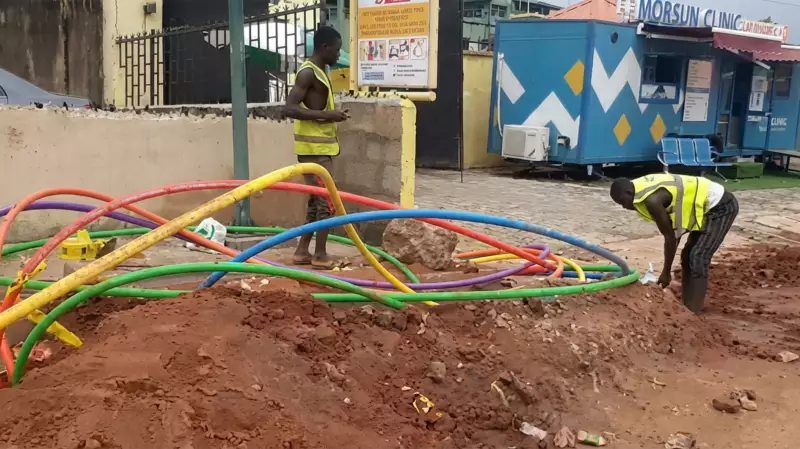
The project will see Nigeria's fibre network expand from an estimated 35,000 km to commence a 90,000 km rollout, aiming for a total of approximately 125,000 km. This new backbone will operate on an open-access, wholesale basis, a structural shift designed to foster competition by allowing smaller ISPs and MNOs to lease capacity fairly, thereby breaking the near-monopoly of existing major players.
Dr. Bosun Tijani, Minister of Communications, Innovation and Digital Economy, stated that this fibre rollout will drive down wholesale bandwidth costs, which should translate to more affordable data tariffs for consumers. He emphasised that 2025 was an "inflection year" focused on laying foundations, while 2026 will be decisively about deployment and impact.
The architecture is designed with seven regional backbone rings covering all six geopolitical zones and Lagos, ensuring high network resilience. It specifically targets all 774 Local Government Area (LGA) headquarters with points of presence (PoPs), which will act as hubs to connect 38,800 public schools and 16,900 health facilities, among other critical services.
The Satellite Revolution: Connecting the Unreachable
While fibre addresses density, satellite technology is the game-changer for ubiquity and resilience. The government recognises that traditional networks fail to reach vast rural, riverine, and border communities due to terrain, insecurity, and cost.
Satellite solutions, including the expansion of NigComSat and partnerships with Low-Earth Orbit (LEO) providers like Starlink, are seen as the pragmatic bridge to connect an estimated 23 million unconnected Nigerians. Airtel Africa's agreement with Starlink will see satellite-to-mobile services begin in 2026 with data for select apps and text messaging, eventually offering high-speed connectivity to smartphones.
The NCC is prioritising Direct-to-Device (D2D) satellite services in its 2025-2030 roadmap, allowing standard phones to connect directly to satellites in signal blackspots. Furthermore, plans are underway to replace NigComSat-1R with new High-Throughput Satellites (HTS) for greater bandwidth.

Telecom expert Kehinde Aluko noted that satellite is vital for network resilience, acting as a fallback during fibre cuts. However, he highlighted challenges, including the high cost of user equipment and the need for a regulatory framework that encourages MNO-satellite company collaboration.
Supporting Infrastructure and Critical Challenges
To support the data surge, the sector is witnessing a push for more data centres. Ikechukwu Nnamani, CEO of Digital Realty Nigeria, stressed that Nigeria needs about 72 edge data centres to power its economy and achieve true digital competitiveness, moving beyond the current concentration of over 90% of data infrastructure in Lagos.
A key challenge for 2026's success is securing physical assets. The expected visible enforcement of the Critical National Infrastructure (CNI) designation for telecom assets is crucial. The NCC reported over 19,000 fibre cut incidents from January to August 2025 alone, with vandalism and road construction as primary causes. Stronger enforcement and penalties are seen as non-negotiable for protecting investments and ensuring network uptime.
In conclusion, 2026 represents a pivotal year where the combined force of fibre and satellite revolutions, supported by data centre expansion and stronger asset protection, will test Nigeria's ability to finally achieve deep, ubiquitous digital inclusion nationwide.