Nigerian Artists Charting the Contours of Modern Life
Stepping into a gallery these days, one can immediately sense a shift in the Nigerian art scene. A new generation of artists is using their work to go far beyond mere decoration. At the heart of this transformation is the Golan Heights Renaissance collective, a group united by their shared training at Auchi Polytechnic. Their recent presentation, titled Reinvention, demonstrated how these artists employ paintings and mixed media as a mirror for society. Rather than focusing solely on color or technique, their work captures the struggles and emotions that people rarely express aloud. Through their art, they explore complex themes like urban hardship, identity, and the quiet resilience of the Nigerian people, turning the gallery into a space for telling relatable, essential human stories and questioning the world around us.
Speaking with the Guardian Life, these artists shared the concepts behind their work and how they use their unique artistic languages to offer both critique and hope. For them, art is not only about color, beauty, or technique. It is also a way of telling human stories, questioning society, and giving shape to emotions that words may not fully capture.
Urban Housing and Economic Pressures
Heyman Ogbemi, in his Single-Room series, confronts the harsh realities of urban housing under current economic pressures. His acrylic paintings depict a middle class struggling against rising rental costs, often contrasted with the detachment of the wealthy elite. Emmanuel Isiuwe, in his At Rest series, employs a verisimilitude-nous approach to capture the stillness of sleep and the shifting landscape of landmarks like the Iyana Ipaja bus stop in Lagos, documenting the changing face of the city.

Psychology of Urban Living
The exhibition also delves into the psychology of urban living. Dolapo Ogunnusi’s textured acrylics oscillate between riverine settlements such as Okobaba and the chaotic rhythm of non-riverine cityscapes. His mixed-media diptychs, notably Open Doors and Ojularin, probe the duality of human nature—the face that presents itself to the world and the mind that remains concealed. Ademola Akinleye’s collages weave Ankara fabric motifs with lines suggesting shattered glass, serving as a study of immateriality and cultural validation.
Cultural Critique and Tradition
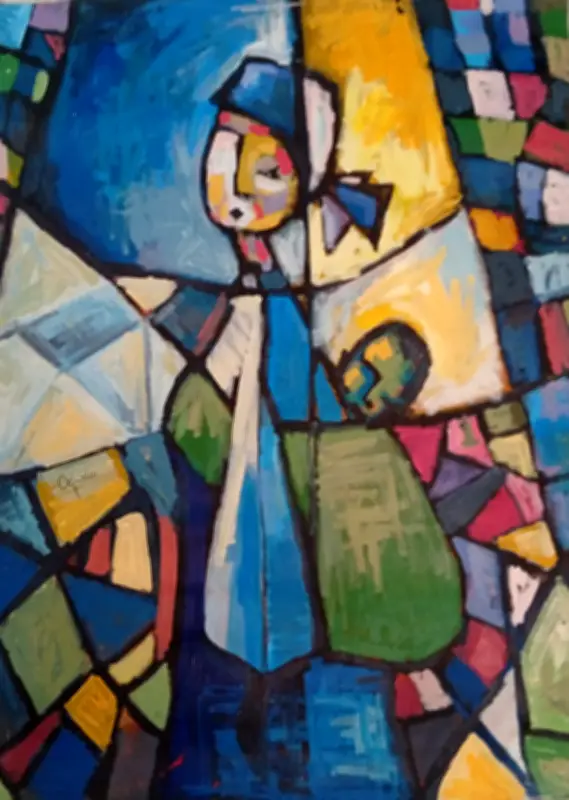
Paul Ayokhai utilizes artistic synecdoche, referencing the legacies of mentors like Ben Osaghae and Olu Ajayi, to critique the social fallout of extravagant lifestyles. Gbenga Olatunji-Aguda, working despite a physical limitation, produces mixed-media paintings with a sculptural depth that demands attention. His work addresses persistent issues of tribal bigotry and leadership responsibility, while pieces such as Big Masquerade ground his practice in the tactile reality of traditional African symbols like peeled palm fronds. Thomas Oghale Agboge showcases a rhythmic exploration of community. Influenced by the cubist legacy of masters such as Rufus Ogundele and Muraina Oyelami, his portraits of musical ensembles reflect on the role of art in fostering intimacy and social bonds.
Conclusion
The Reinvention exhibition stands as a testament to the power of art to document, critique, and inspire. These artists are not merely creating beautiful objects; they are mapping the contours of modern life, offering both a mirror and a window into the Nigerian experience. Through their diverse practices, they remind us that art can be a vital tool for social commentary and human connection.