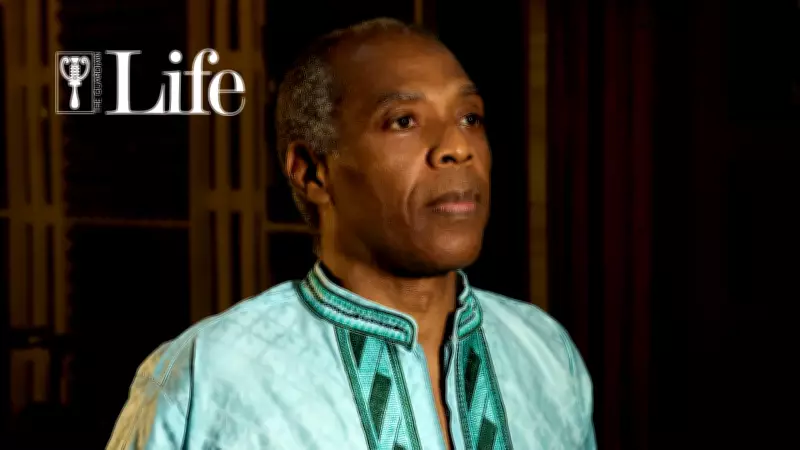
For more than four decades, Femi Kuti has stood where music meets conviction, carrying Afrobeat as both inheritance and instrument. His work has long done more than entertain. It has challenged power, documented frustration and given rhythm to resistance, while asking difficult questions about the society around him.
But time has a way of deepening even the most defiant voices. At this stage of his life and career, Kuti seemed less interested in repeating old battles and more concerned with what they had taught him. The fire is still there, but so was the reflection. What came through now was not only protest, but introspection. That shift sits at the centre of Journey Through Life, the album he is touring in the United Kingdom this April.
In an interview with Guardian Life, conducted amid a run of shows through London, Bristol, Manchester, Leeds and Glasgow, Kuti speaks about music, politics, fatherhood, betrayal, endurance and the personal code that had kept him moving through decades of pressure and reinvention.

Returning to the UK with Journey Through Life
You have returned to the UK with your Journey Through Life tour. What does this moment mean for you at this stage of your career?
For four decades of my career and still counting, I feel so great to be on stage. It is an honour for me to be able to inspire people. That is what this stage of my career means to me. After so many years in music, to still have people listen, connect and find meaning in what I do is something I do not take for granted.
Why Journey Through Life?
Why did you choose Journey Through Life as the title of the album?
I wanted people to see the rules that govern me. The title reflects the virtues that guide me and the things I have passed through in life. It speaks to humility, growth and self-reflection. I wanted people to see that side of me in the music, because the album is not just about sound, it is also about the values and experiences that have shaped me.
Personal Experiences and Favourite Track
What personal experiences shaped the songs on Journey Through Life, and which track would you call your favourite?

I would say my favourite track there is Work on Myself. We are not just losing politically, and this is not only in Nigeria, but globally. There is so much depression everywhere. When I think about Marcus Garvey, Malcolm X, Martin Luther King, Dr Kwame Nkrumah, Patrice Lumumba, my father, my mother, Thomas Sankara, Muhammad Ali, Bob Marley, there was a kind of hope, African unity, world peace, but as the years go by, things have been getting more out of reach. So I said to myself, if my music or saxophone cannot change this world, I know one thing I can change, which is to make myself a better person, so I hope the tracks will inspire people who feel the way I feel that we shouldn’t lose hope that we can make ourselves better human beings. I can make myself a better father, better musician, but without losing hope, there has to be light at the end of the tunnel. I found that a lot of people who complain about the government or issues, when they get the opportunity to lead, become worse than the previous person. We are all quick at criticising, but we are bad parents. We are bad professionals, we are corrupt, we are just not even virtuous in our daily lives, or in our being. I think this is probably one of the forces of global attitude. One of my songs, Work on Myself is a song to help all of us, and of course, I speak not just for myself. I think even musicians and composers need to listen to the lyrics of what we sing. Sometimes, we do not even sit down to examine our own thoughts. I think we are just mediums that higher forces use, and we need to listen to ourselves as well. So, I think it is very important, as a composer and as a musician, to listen to your own lyrics and abide by the standard you have already set in your songs. Otherwise, you just write songs that you do not really mean. That is a human attitude or behaviour. We talk, we don’t practice what we teach, so that is the song that I think is very important for me at this point in my life, not to fall victim. To be critical, and if the opportunity comes, I’ll do the same thing. So, I have the opportunity, for instance, to still be touring at my age. Should I take it for granted? Of course not. Every night, as you can see from the videos, I try to give even more. I want people to watch and feel inspired. I also want to be happy with myself and know that I gave my best. So that’s one of the best tracks in terms of lyrics and music.
Maintaining Energy and Discipline
Your stamina is something many people admire. You performed 24 shows in one month during your North American tour. How have you been able to maintain that kind of energy and discipline?
Dedication, professionalism, that is how I see it, and that is how I live. If you listen to my lyrics in Journey Through Life, the message is simple: do what you love. If you truly love what you do, you may not even realise that 20 years have gone by because you are not counting the time. You are not thinking only about money. You are focused on the work itself. Every profession should carry that kind of attitude. A doctor, for example, should want to save lives. But we see many medical practitioners who are more interested in the money. They ask for payment before they save your life. It is the same in many other professions. People forget the real reason they chose that path in the first place. But if it is truly what you want to do in life, time passes without you even noticing. You remain grateful and happy because you are doing what you love. That is how I see fatherhood, too. I am happy to be a father. I love being a father, and I love my children. I have no complaints about that, even though I know it is a big responsibility to look after children. Some people just want to have children, but they do not care for them. Yet raising a child is a serious duty because you are responsible for another life. That is my attitude to life. This is what I love doing. That is why I put myself fully into it. So every night, I gave 100 per cent. No excuses. The show must go on. We have to be very professional.
Pressing Issues: Politics and Governance
Your music has always carried strong social and political messages. What issues are pressing most on your mind right now?
Everything is pressing on my mind. If you listen to tracks like Sorry Sorry, you will realise that I wrote about many of these issues years ago. When I released some of those songs and said politicians and soldiers were the same, a lot of people insulted me. But look at where we are now. Many of the things I sang about then are still happening today. Politicians are even worse than the soldiers. If you go back to 1999, people were talking about the refineries not working, electricity not working, and all the things politicians promised they would fix. What did they really fight for? Was it for the people, or for personal gain? We voted because we wanted better lives. Look at what is happening now. The opposition is made up of many of the same people who have already been in government. They had the opportunity to make things right. Did they do it? No. I have been speaking about these issues for years, and people still abuse me for it. But if this government fixed the refineries, a Nigerian should be enjoying the resources of this country. There should be equal opportunity for everybody. Our children should not be on the streets selling things. They should be in school. Instead, oil blocks are given to friends and family, and the wealth is shared among themselves, who become billionaires while health, education, electricity and other institutions collapse. They have systematically destroyed the country. Every single one of them has a share of the blame.
Can Things Change in Nigeria?
When you look at governance in Nigeria, do you still believe things can change?
Things can only change if we fix the foundation of the system. The same people keep moving from one side to another and presenting themselves as the solution, even though many of them have already had the chance to make things better and failed. We all know the truth about what is happening in this country, but too many people compromise. Until there is honesty, accountability and real concern for the people, the cycle will continue.
Healthcare Concerns
You also spoke strongly about healthcare. What worries you most about Nigeria’s health sector?
What worries me is the hypocrisy in it all. The same leaders who should build strong hospitals here are the ones travelling abroad for treatment. Why should that be normal? We have brilliant doctors in Nigeria, but many of them leave because the system does not support them. There was a time when Nigeria had institutions and hospitals that people respected. Today, so much has been destroyed by bad leadership, and the ordinary person is left to face the consequences.
Fela’s Grammy Lifetime Achievement Award
Fela Anikulapo-Kuti’s Grammy Lifetime Achievement Award was celebrated across Africa. What did that recognition mean to you personally?
I was happy about it. We celebrated it.
The Saxophone and Its Role
Your family is known for its musical gifts, and the saxophone is part of it. How did it become central for you?
I moved to the saxophone mainly because my father played it and gave it to me to play. My father has a cousin called Okanlawon who taught me the skill of C major, and that was the end of that matter. I used to play the trumpet before then, but the saxophone became natural for me because of that influence. It grew with me and became part of my identity as a musician. For Made, he is a multi-instrumentalist. He plays guitar, trumpet. In his first album, he played all the instruments. He is versatile.
Health Implications of Performing
This saxophone you have been carrying and playing for years, does it have any health implications for you as a performer?
There is nothing in this life that does not come with its own challenges. I do not think there is any profession where you will not feel the effects one day. When you play so often, of course, it will affect you. If you are a performer like me, you will feel body pain. But if you enjoy it, if it is your life, you have to do what you love. If you do not do what you love, it will feel like you are forcing yourself, and that cannot work. Yes, your fingers may hurt, or your neck, but there is nothing in this life that is easy.
Made Kuti Carrying the Torch
What are your thoughts on Made Kuti carrying the torch?
Made is a great guy. He has the best character and is every parent’s delight. I can only be thankful. I believe I have been a good parent, although sometimes even good parents have children who do not listen. Made is a child who listens, and he is a good example to his brothers and sisters, who look up to and admire him. He is such a responsible young man. In my family, Made makes all of us very proud.
Looking Back: Regrets and Moving Forward
If you had the opportunity to go back in time and change one thing, what would that be?
It has happened, and it is gone. I made terrible mistakes in my life, but I learned from them and warned my children not to make the same mistakes. But do I want to go back? That is foolish thinking. I know it is not possible. I move forward; I do not go back. If I dwell on anything, it is only to make sure it does not happen again. Close friends have betrayed me all my life. If you betray me now, I will just hiss, and it will not affect me the way it used to. In this life, it is very important to be on the side of righteousness. You will survive. Some of my musicians ran away in America. I sat down, and I was broken, but I still finished the 24 dates. With just one phone call, American musicians came and joined me, and we completed the tour. They thought they would destroy me, but they failed because I am not a bad person. I try to be good every day. They blame me for the political situation. Am I the president? I got visas for you, then you paid for your ticket, and you still ran away, only to turn around and blame me that Nigeria is bad.