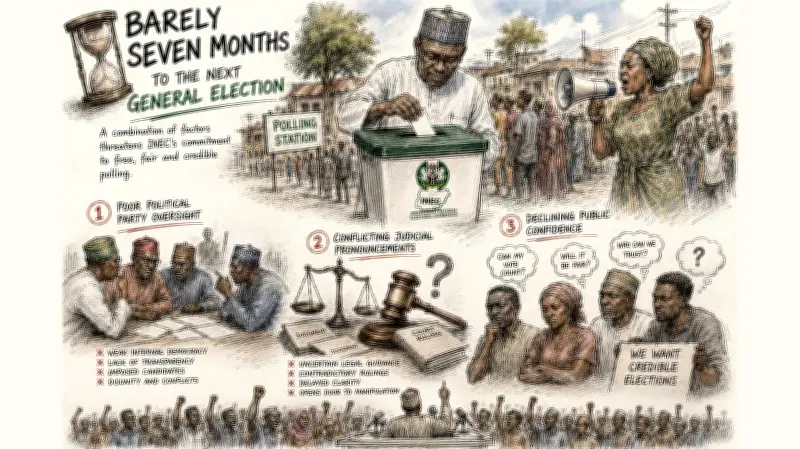
Barely seven months to next year's general election, concerns are mounting over the Independent National Electoral Commission's (INEC) ability to deliver a free, fair and credible poll, amid conflicting judicial pronouncements, weak oversight of political parties and growing public distrust in key democratic institutions. Checks by The Guardian indicate that the recent Federal High Court order directing INEC to delist five opposition political parties has heightened concerns about the commission's ability to keep to its timetable ahead of the 2027 general election.
According to stakeholders, the electoral body's struggle to navigate conflicting judicial pronouncements at a critical stage of preparations for candidate nominations and listings on the INEC portal poses a serious threat to the transparency, predictability and credibility of the electoral process. They, therefore, urged INEC to remain focused on its mandate of delivering inclusive and credible elections, while calling for urgent judicial reforms to minimise uncertainty and strengthen public confidence in the electoral system. They also stressed the need for political actors to conduct themselves responsibly in the interest of democratic stability.
However, academics and legal practitioners who spoke to The Guardian differed on whether the recent court rulings amount to an erosion of INEC's independence, maintaining that constitutional safeguards and judicial oversight remain integral to ensuring accountability within the electoral process.

Expert Views on Court Interventions
A lecturer in the Department of History at the University of Ilesa, Osun State, Adebukola Ayoola, maintained that court orders on the eligibility of political parties not only impair INEC's independence but also reinforce perceptions that the commission's leadership has been compromised. “It is an embarrassment to the electoral system and the entire country. The ruling class is always manipulating the system and using every available means to seize and retain power. The judiciary has to wriggle itself out of the clutches of the executive, which has turned it into a puppet to achieve its desires at all times.
“From all indications, INEC under its current leadership has shown that it is grossly incompetent in discharging its responsibilities and doing so in a just and fair manner, as expected of an unbiased umpire,” Ayoola stated. He remarked that the conflicting judicial pronouncements were deliberate attempts to truncate democracy in Nigeria, lamenting that those behind them were trying to abort a pregnancy after the baby had already been delivered.
He said, “Both INEC and the judiciary have been compromised. So, anything and everything is believed to be possible by the ruling class. I doubt they will succeed this time. Whatever we are witnessing is contrary to the provisions of the Electoral Act. And the executive, together with the ruling class, should stop the nonsense before the situation degenerates into a state of anarchy or revolution. The people will not sit quietly and watch. This is a calculated attempt to install the ruling party's candidates rather than allow them to emerge through a contested election. That is a disregard for the people's right to make their choices.
“The ruling class must stop the manipulations and political shenanigans. They need to respect the Electoral Act and allow the people's will to prevail. If their candidates are popular, they will definitely win. If the ruling class is convinced that it has performed fairly well so far, it has no reason to be afraid of losing the election.”
INEC Denies Anti-Opposition Agenda
Meanwhile, the Chief Press Secretary and Media Adviser to the INEC Chairman, Adedayo Oketola, has described allegations that the commission is working to stifle opposition parties as baseless and contrary to its documented record. According to him, “Under the leadership of Professor Joash Amupitan, SAN, the Commission has consistently demonstrated that its loyalty lies strictly with the electorate, not any political interest.

“We do not have a preferred candidate or favoured party. Our sole focus is to uphold the rule of law and protect the sanctity of the electorate's mandate. Suggestions that the Commission is compromised ignore the reality of an umpire that has deliberately insulated the electoral process from political interference. Our track record in the Anambra State governorship election and the FCT Area Council polls clearly demonstrates our independence. The same will be evident in the Ekiti State governorship election scheduled for Saturday, June 20. In each case, outcomes were determined solely by voters' choices at the polling units. An opposition party won in the FCT under Amupitan's leadership, which would have been impossible if the Commission were tilting the playing field in favour of the ruling party.”
Oketola added that the Bimodal Voter Accreditation System (BVAS) remains the Commission's strongest safeguard against electoral manipulation. “BVAS has eliminated identity theft, arbitrary vote allocation and the use of manual incident forms. If a voter's biometrics do not match our secure database on election day, that person cannot vote. In addition, by uploading photographed polling unit result sheets directly to the INEC Result Viewing Portal (IReV), we have moved result collation into the public domain for all Nigerians to scrutinise.
“As we finalise preparations for the Ekiti governorship election and conduct legislative bye-elections across six states this weekend, our focus remains on strengthening capacity ahead of the 2027 general elections. We urge political actors to move away from pre-election panic narratives and instead concentrate on voter mobilisation and the training of polling agents. INEC remains an impartial and dispassionate umpire, and we assure Nigerians that every valid vote will count and that only the true will of the people will be reflected in our declarations,” he said.
Judicial Oversight and Independence
Also, the coordinator of the Pelex Centre for Civic Education Initiative, Courage Nsirimovu, argued that court pronouncements do not, by themselves, impair INEC's independence. According to him, the judiciary has a constitutional responsibility to adjudicate disputes brought before it, including matters concerning the electoral commission. He, however, cautioned that judicial interference would arise where courts make pronouncements on issues not presented before them or issue decisions that encroach on INEC's constitutional decision-making powers.
He also noted that judgments considered manifestly perverse on matters relating to party structures or electoral administration could amount to undue interference with the commission's independence. “Constitutional provisions,” he stressed, “should be interpreted holistically. A political party that fails to secure the required presidential votes may still retain its registration if it satisfies the constitutional requirements in governorship or legislative elections. Consequently, if INEC fails to properly apply these constitutional provisions before deciding on deregistration, such an omission would reflect a lapse in its constitutional responsibilities.”
On the impact of ongoing litigation on election planning, Nsirimovu maintained that court actions challenging party structures and eligibility remain lawful until legislation prescribes timelines restricting such cases. Although such litigation may complicate election planning, he argued that it cannot be regarded as unlawful interference with INEC's preparations.
Similarly, legal practitioner and policy analyst, Living Jamala, explained that under the constitutional doctrine of separation of powers, the judiciary serves as a constitutional watchdog over the actions of public institutions, including INEC, which he said is a creation of the Constitution and remains subject to judicial review. Jamala, however, agreed that the court's intervention subtly exposed shortcomings in INEC's regulatory oversight. While the Constitution empowers the commission to deregister political parties that fail to satisfy legal requirements, he observed that INEC has rarely exercised those powers proactively, leaving the courts to intervene.
He further argued that election-related litigation can arise at any stage of the electoral process where constitutional or statutory violations are alleged. Citing previous judicial decisions, including disputes involving the All Progressives Congress in Rivers State in 2019, where the court disqualified all candidates for failing to comply with court orders during party congresses, he noted that courts have consistently invalidated elections where party primaries or congresses failed to comply with constitutional, statutory or party guidelines.
“The declaration of election winners does not extinguish the right of aggrieved parties to seek judicial redress where legal infractions are established. This reinforces the judiciary's constitutional role in safeguarding the integrity of Nigeria's electoral process,” he added.
Call for Reforms
A former House of Representatives candidate for Ibadan North Federal Constituency, Olajumoke Odususi, noted that while litigation remains a constitutional right that cannot be denied simply because election preparations have commenced, there is a legitimate concern that prolonged or last-minute litigation could disrupt electoral planning, create confusion among voters and place unnecessary pressure on INEC.
“Therefore, while such cases are legally permissible, they should be resolved expeditiously to prevent disruption of the electoral calendar,” she declared, stressing that a healthy democracy requires both an independent electoral commission and an independent judiciary. “Neither institution should undermine the other. While the courts must retain the power to review INEC's actions, judicial interventions should be timely, consistent and guided by the overriding public interest of ensuring credible, peaceful and well-organised elections.
“Similarly, political parties must embrace internal democracy and respect the rule of law to reduce avoidable disputes that threaten electoral stability.” On the suggestion of a similar 180-day threshold for litigation involving political parties before a general election, Odususi said there was a strong case for introducing statutory timelines for party-related disputes, especially those concerning party leadership, membership, registration and eligibility.
“Just as election petitions are subject to strict timelines, party disputes that have the potential to affect elections should be concluded within a specified period before the election cycle reaches critical stages. This would promote certainty, reduce last-minute judicial interventions and allow INEC to focus on election administration without avoidable distractions,” she asserted.
She highlighted several measures needed to restore order in both the judiciary and political parties and strengthen the credibility of the electoral process, noting that judicial reforms remain crucial. According to her, such reforms should include strengthening internal mechanisms within the judiciary to discourage conflicting judgments and forum shopping. “Electoral and political cases should be assigned to specialised courts or designated judges with expertise in electoral law.
“Other measures include the speedy resolution of cases through stricter timelines for determining pre-election and party-related disputes. Political parties must strengthen their internal dispute-resolution mechanisms and comply with their constitutions to reduce unnecessary litigation. The National Assembly should consider amendments to electoral laws that provide greater clarity on party regulation, registration, leadership disputes and timelines for legal challenges. The National Judicial Council should continue to monitor and sanction judicial misconduct where necessary.
“There should also be regular engagement among INEC, political parties, the judiciary, civil society organisations and security agencies to identify and resolve potential areas of conflict before they escalate.”
Legislative and Political Reactions
However, placing the responsibility on INEC, the Minority Caucus of the House of Representatives urged the electoral umpire to resist any attempt to undermine Nigeria's democratic process. The caucus warned against actions capable of weakening opposition parties ahead of the 2027 general elections, alleging that the ruling formed part of a broader effort to create confusion within the political system and frustrate opposition parties ahead of the polls.
Addressing a press conference at the National Assembly yesterday, Minority Leader Fred Agbedi expressed concern over the recent Federal High Court judgment ordering the deregistration of five political parties, describing it as a threat to political pluralism and democratic participation. INEC, the caucus said, must not allow itself to be used to undermine democracy, particularly in the face of conflicting judicial pronouncements on the status of political parties.
“The Chief Justice of Nigeria must wade into the conflicting judgments on party registration to save the judiciary from further embarrassment. INEC must resist being used to sabotage democracy. We will not accept a 2027 election rigged before it begins,” the caucus stated.
The lawmakers argued that the affected political parties had satisfied the legal requirements for continued registration, noting that INEC had informed the court that the parties had won elective positions in previous elections. Describing the development as part of a series of obstacles allegedly being placed before opposition parties, the caucus stated: “From external manipulations and executive meddlesomeness that have kept old political structures polarised to attempts to frustrate new alliances through institutional bottlenecks, such as the refusal to register new political parties, the overall objective has been to push all credible opposition parties out of the 2027 contest.”
While commending the Court of Appeal for halting the implementation of the judgment, the lawmakers urged Nigerians to remain vigilant against attempts to undermine political pluralism and democratic competition.
Meanwhile, the Conference of United Political Parties (CUPP) maintained that political parties must unite to safeguard democracy, warning against any attempt to undermine Nigeria's multiparty system through the arbitrary deregistration of political parties. In a statement made available to The Guardian, the Acting National Chairman of CUPP, Peter Ameh, stressed the need for political parties to remain united in protecting democratic values and constitutional freedoms.
Recalling the mass deregistration of political parties six years ago, he described the exercise as undemocratic, arguing that it weakened political pluralism and limited opportunities for emerging parties to grow and contribute to national development. According to him, the African Democratic Congress (ADC), under the leadership of Chief Ralph Okey Nwosu, stood with other affected parties in resisting the action at the time.
“A stronger and more coordinated opposition to the deregistration exercise would have significantly curtailed the systematic effort to shrink Nigeria's democratic space. Had we remained united and collectively resisted, we would have significantly weakened the plot to deregister political parties that deserve the opportunity to grow organically.”
Drawing inspiration from German pastor Martin Niemöller's famous poem, First They Came, Ameh warned that silence in the face of injustice could ultimately threaten all political actors, regardless of affiliation. He argued that democracy flourishes when diverse political voices are allowed to compete freely and citizens are presented with genuine electoral choices.
Ameh further condemned what he described as “hostile executive rascality and brazen judicial overreach”, insisting that any move aimed at suppressing political parties poses a serious threat to democratic governance. He, therefore, called on political parties, civil society organisations and pro-democracy groups to work together to safeguard Nigeria's democratic institutions and preserve citizens' constitutional right to political association.
“The only thing necessary for the triumph of evil is for good men to do nothing,” he said, urging stakeholders not to remain passive when democratic principles are under threat. The CUPP chairman maintained that protecting the country's multiparty democracy is a collective responsibility and warned that efforts to weaken political parties could erode public trust in the electoral process and democratic institutions.
Lawyers Seek Reforms to Curb Election-Related Litigation
A lawyer, Ogochukwu Onyema, has argued that it does not amount to interference in the electoral process for aggrieved parties to approach the courts after the Independent National Electoral Commission has published the timetable and schedule for elections. Speaking on the role of the judiciary in electoral matters, Onyema said judges have a responsibility to balance the interests of the state, plaintiffs and defendants when adjudicating election-related disputes.
According to him, while individuals have a constitutional right to seek judicial redress, courts must exercise caution in issuing rulings that could disrupt the electoral process. “People come with frivolous applications to create crises in the system, especially during elections. You cannot stop them from filing such applications because it is their right. The concern should be the nature of the rulings that emerge from such cases, particularly when elections are approaching or party primaries are about to be conducted,” he said.
The lawyer criticised a recent Federal High Court judgment directing INEC to deregister some political parties, describing it as a decision capable of destabilising the political system. He argued that such judgments should take into account their potential impact on democratic governance and electoral stability.
Onyema also expressed concern over what he described as declining confidence in Nigeria's judicial system, citing the growing preference by parties in international business transactions to subject agreements involving Nigerian entities to foreign jurisdictions and international legal frameworks. According to him, the trend reflects concerns about the credibility and predictability of judicial outcomes in the country.
He maintained that efforts to strengthen democratic institutions should include reforms aimed at improving judicial integrity and safeguarding the electoral process.
Also speaking, another lawyer, Chike Nwachukwu, backed proposals for reforms that would restrict litigation over electoral matters once INEC has issued the timetable and notice for elections. He argued that such measures could help minimise disruptions to election planning and enhance certainty in the electoral process.