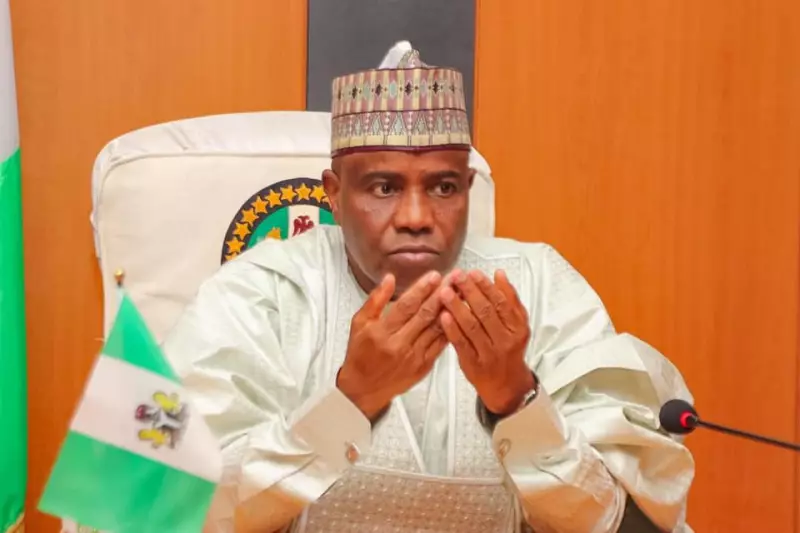
Former Sokoto State Governor and one-time Speaker of the House of Representatives, Aminu Tambuwal, has made a startling declaration about the state of Nigeria's democracy. He asserted that the final results of elections in the country are not entirely determined by the ballots cast by citizens.
Collation Process Identified as Major Weakness
Tambuwal presented his views during an interview on Prime Time, a political programme broadcast on Arise Television, on Monday, January 12. He explained that while Nigerians perform their civic duty by voting, the genuine outcome is frequently misrepresented at subsequent stages.
"Elections are not completely decided by electorates. I can say that without mincing words," the former governor stated emphatically. He pinpointed the collation system as a critical failure point, where the people's will can be subverted.

According to him, distortions can happen at any level—from the polling units and wards to local government, state, and even the national collation centre. "Things happen that misrepresent what voters actually voted for," he lamented.
Calls for Reform and Critique of INEC
Tambuwal accused savvy politicians of routinely exploiting vulnerabilities within the electoral framework, particularly during the collation and transmission of results. He also did not spare the Independent National Electoral Commission (INEC), alleging that certain officials within the body play a role in compromising electoral integrity.
However, the former governor expressed strong optimism about potential solutions. He voiced unwavering support for comprehensive reforms designed to strengthen Nigeria's electoral system. A key measure he endorsed is the adoption of electronic transmission of results.
"I wholeheartedly support any reform that will improve the electoral process in Nigeria, including electronic transmission," Tambuwal affirmed.
Political Parties Lack Ideological Foundation
Moving beyond logistics, Tambuwal also delivered a pointed critique of Nigeria's political parties. He argued that most parties are not driven by any core ideology but instead function merely as vehicles to achieve power.
To illustrate his point, he posed a rhetorical question about former President Muhammadu Buhari's political alliances. "If it's about ideology, what was President Muhammadu Buhari doing in the APC with some characters that we have in APC?" he asked, suggesting that ideological incompatibility is common.
He further admitted that even within his own coalition-backed African Democratic Congress (ADC), there are members who, based on ideology, should not be political allies. This observation underscores his view that Nigerian politics is largely built on convenience rather than conviction.