Brazilian President Issues Stark Invasion Warning to South Africa Amid Middle East Escalation
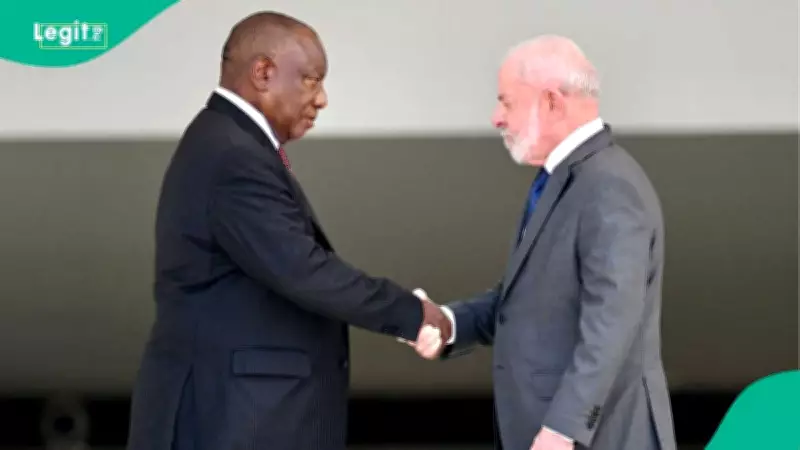
In a dramatic diplomatic exchange, Brazilian President Luiz Inacio Lula da Silva has urgently called upon South African President Cyril Ramaphosa to fortify bilateral defense cooperation, explicitly warning that both nations face imminent vulnerability to foreign invasion. This high-stakes conversation occurred as President Ramaphosa visited Brazil, with both leaders expressing strong criticism of the United States and Israel's ongoing military campaign against Iran.
"Prepare for Invasion": Lula's Dire Warning to African Counterpart
President Lula delivered his cautionary message with striking clarity during discussions with President Ramaphosa. "I don't know if comrade Ramaphosa realises that if we don't prepare ourselves in terms of defence, one day someone will invade us," the Brazilian leader stated emphatically. This warning comes against the backdrop of heightened global tensions following the assassination of Iranian Supreme Leader Ayatollah Ali Khamenei by joint US-Israeli forces on February 28, 2026.
The Brazilian president specifically highlighted the need for reduced dependence on foreign arms suppliers, advocating instead for enhanced collaborative defense production between Brazil and South Africa. "We need to see what we can produce together. We don't need to keep buying from foreign arms suppliers," Lula emphasized during the meeting, as reported by TRT Afrika.

South African Response and Defense Cooperation Plans
President Ramaphosa acknowledged Brazil's advanced capabilities in aviation and defense sectors while emphasizing mutual learning opportunities between the two nations. "Brazil is more advanced than South Africa when it comes to aviation and defence. However, we both have so much to learn and show each other," Ramaphosa noted during the discussions.
The defense ministers of both countries are scheduled to convene on Monday, March 16, 2026, to formalize a comprehensive defense agreement. President Lula contextualized this cooperation within South America's peaceful continental identity, stating, "We have presented ourselves as a continent of peace, and that no one has a nuclear weapon and that none of us is developing a nuclear bomb. So we think of defence as deterrence."
Geopolitical Context: BRICS Alignment and Global Reactions
Both Brazil and South Africa maintain membership in the BRICS economic bloc alongside China, Russia, and Iran, positioning them within a geopolitical framework that has frequently opposed Western military interventions. The assassination of Ayatollah Khamenei has triggered significant regional escalation, with Iran conducting retaliatory strikes against Israeli and US facilities across Middle Eastern nations including Saudi Arabia, Qatar, and Dubai.
In a related development, the United States designated the Sudanese Muslim Brotherhood as a terrorist organization on March 9, 2026, alleging connections to Iran's Islamic Revolutionary Guard Corps. This designation was announced by US Secretary of State Marco Rubio as part of broader efforts to counter Iranian influence.
International condemnation of the US-Israeli operation extends beyond Brazil and South Africa, with several European nations including the United Kingdom and Spain expressing disapproval. Meanwhile, religious leaders like Sheikh Habibullah Adam have projected further regional destabilization, noting that global powers including China, Russia, and North Korea are closely monitoring developments with potential future involvement.
The defense discussions between Brazil and South Africa represent a significant strategic realignment as emerging economies seek to enhance their security autonomy amid escalating great power conflicts that threaten to spill beyond traditional regional boundaries.