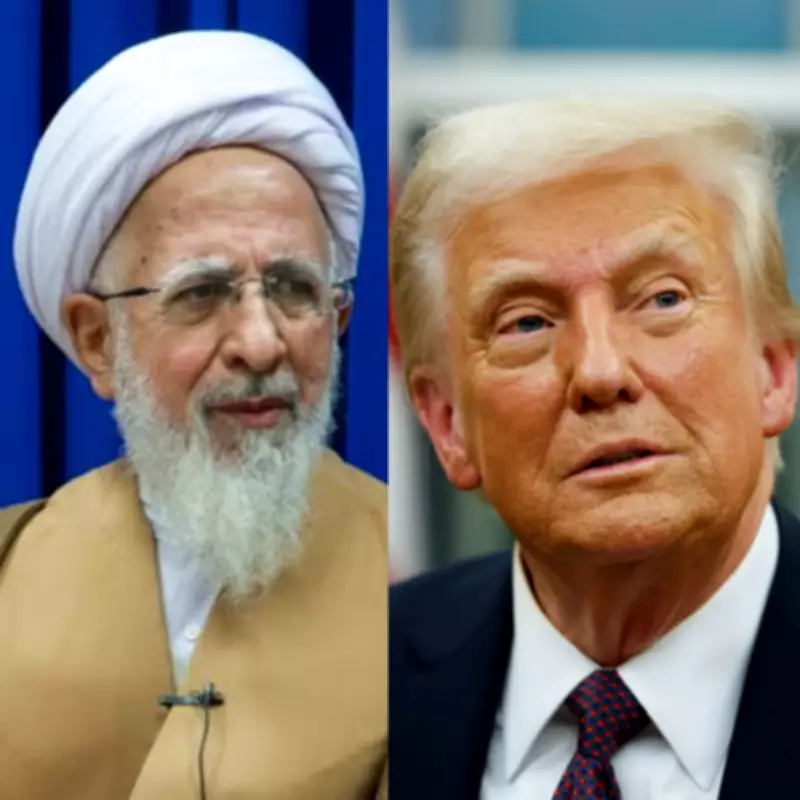
Iran's New Leader Issues Violent Call Against Trump and Zionists Amid Escalating Conflict
Iran's newly appointed leader, Abdollah Javadi Amoli, has made a shocking and inflammatory statement, explicitly calling for "the shedding of Zionist blood" and "the shedding of Trump's blood." In a televised address on state television, Amoli urged viewers to engage in violent confrontation, declaring, "Fight the oppressive America, his blood is on my shoulders." He emphasized the critical nature of the current situation, stating, "We are now on the verge of a great test and we must be careful to fully preserve this unity, to fully preserve this alliance."
Background of Escalating Tensions and Military Strikes
These provocative remarks follow a significant escalation in hostilities, as the United States and Israel launched a coordinated military operation on Saturday, February 28. The operation targeted key Iranian assets, including its leadership, missile arsenal, and nuclear program, with officials suggesting that toppling the Iranian government is a primary objective. This aggressive move has triggered a wave of violence and retaliation across the region.
In response, calls for jihad have proliferated in online chats linked to the Islamic Revolutionary Guard Corps, urging supporters in Iran, Iraq, Lebanon, and Pakistan to "burn the embassies and assets" of perceived enemies. The conflict has already resulted in devastating casualties, with the operation leading to the death of Iran's supreme leader, Ayatollah Ali Khamenei. According to official reports, the war has killed more than 1,230 people in Iran, over 70 in Lebanon, and approximately a dozen in Israel.

Recent Attacks and Retaliatory Measures
In a recent development, Iran launched a new wave of attacks targeting Israeli and American military bases. Iranian officials warned that the United States would "bitterly regret" its actions, particularly referencing the sinking of an Iranian warship in the Indian Ocean. The US Navy confirmed that it sank the Iranian warship on Tuesday night, March 3, resulting in the deaths of at least 87 Iranian sailors.
Iranian Foreign Minister Abbas Araghchi condemned the incident as "an atrocity at sea," stating on social media, "Frigate Dena, a guest of India’s navy carrying almost 130 sailors, was struck in international waters without warning." He issued a stern warning, "Mark my words: The US will come to bitterly regret the precedent it has set."
Ongoing Military Engagements and Regional Impact
The conflict continues to intensify, with Israel announcing multiple incoming missile attacks and air sirens sounding in major cities like Tel Aviv and Jerusalem. Iranian state television reported that additional strikes have targeted US bases, indicating a broadening of the conflict zone. Furthermore, Iran's paramilitary Revolutionary Guard confirmed the launch of large Khorramshahr-4 missiles in an attack on Thursday, March 5, specifically aimed at Israel.
This series of events underscores the volatile and rapidly deteriorating situation in the Middle East, with Iran's new leadership adopting a hardline stance that threatens to escalate into a wider regional war. The international community is closely monitoring these developments, as the calls for violence and ongoing military actions pose significant risks to global stability and security.