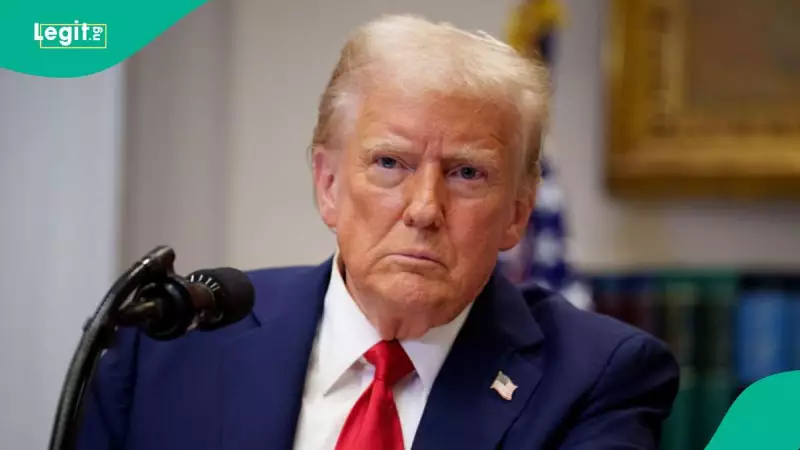
In a move that has sent shockwaves through diplomatic circles, US President Donald Trump has issued an extraordinary letter to Norway's Prime Minister, Jonas Gahr Stoere, demanding 'complete and total control' of Greenland. The communication, dated January 2026, reveals a president deeply frustrated by international snubs and determined to assert American dominance over strategic territories.
A Letter of Demands and Grievances
The letter, a response to a joint message from Norwegian PM Jonas Gahr Stoere and Finnish President Alexander Stubb, quickly escalated from diplomatic dialogue to a list of grievances and ultimatums. President Trump explicitly linked his demand for Greenland to his resentment over being denied the Nobel Peace Prize.
He wrote, 'Considering your Country decided not to give me the Nobel Peace Prize for having stopped 8 Wars PLUS, I no longer feel an obligation to think purely of Peace... but can now think about what is good and proper for the United States of America.' This statement underscores a perceived transactional view of international relations and recognition.

Trump challenged Denmark's sovereignty over Greenland, arguing, 'Denmark cannot protect that land from Russia or China, and why do they have a ‘right of ownership’ anyway? There are no written documents, it’s only that a boat landed there hundreds of years ago.' He positioned the acquisition as a necessary move for global security, concluding, 'The World is not secure unless we have Complete and Total Control of Greenland.'
International Response and Diplomatic Alarm
The letter was a direct reply to an appeal for de-escalation from the European leaders. Stoere and Stubb had written to Trump, referencing tensions over Greenland, Gaza, Ukraine, and recent tariff announcements. They urged collaboration, stating, 'We believe we all should work to take this down and de-escalate - so much is happening around us where we need to stand together.'
Analysts have warned that Trump's stance is dangerously isolating. Anne Applebaum of The Atlantic noted that allies have struggled to explain the President's behaviour, which defies conventional doctrines like isolationism or neo-imperialism. She warned that his actions risk alienating key allies in Europe, India, South Korea, Japan, and Australia, potentially unravelling years of diplomatic and trade progress.
Applebaum stated, 'He is locked into a world of his own, determined to ‘win’ every encounter, whether in an imaginary competition for the Nobel Peace Prize...' This analysis points to a leadership style that prioritises personal victory over strategic alliance-building.
The Greenland Obsession and NATO Leverage
This is not the first time President Trump has fixated on Greenland. Earlier, on January 14, 2026, he took to social media platform X to reiterate the US need for the territory for national security, referencing a 'Golden Dome' project. He argued that NATO, which he claims owes its strength to American power, should facilitate the transfer.
In his post, Trump asserted that NATO's effectiveness is dependent on US military might, which he said he had raised to 'a new and even higher level.' He framed the control of Greenland as a way to make the alliance 'far more formidable and effective' while preempting rival influence from Russia or China.
The combination of personal grievance, geopolitical ambition, and transactional alliance management in these communications has raised profound concerns. Experts fear that this approach could destabilise long-standing partnerships and create unpredictable new flashpoints in global politics, with the icy expanse of Greenland at the centre of the storm.