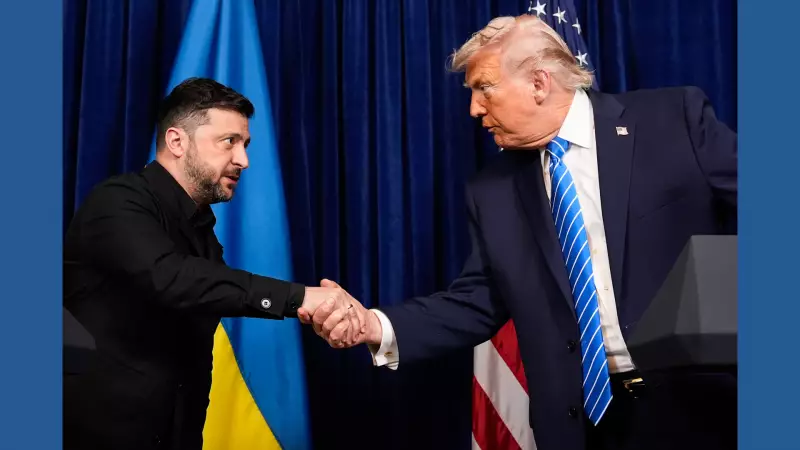
In a major diplomatic development, U.S. President Donald Trump and Ukrainian leader Volodymyr Zelenskiy have declared they are now significantly closer to an agreement aimed at ending the ongoing war in Ukraine. The announcement came after a crucial meeting at the Mar-a-Lago resort in Florida on Sunday, December 28.
Major Strides and Security Guarantees
Following the high-stakes talks, President Trump indicated that a final resolution could become clear within a matter of weeks. He revealed that negotiators are approximately 95% of the way toward a final settlement. A central pillar of the discussions was the creation of long-term security assurances for Ukraine. While President Zelenskiy stated an agreement on these guarantees had been reached, Trump emphasized the need for European nations to take the lead in implementing them, with support from the United States.
This approach was backed by French President Emmanuel Macron, who confirmed that a 'Coalition of the Willing' will convene in Paris this January to finalize concrete contributions to Ukraine's future security architecture.

The Thorny Issue of Donbas
Despite the progress, significant obstacles remain, primarily concerning the disputed Donbas region. Russia continues to demand full control of the territory, while Ukraine is pushing for a freeze of the current battle lines to prevent ceding any ground held by its forces. To find a middle path, U.S. negotiators have put forward a proposal for establishing a free economic zone in the Donbas. However, the practical details of such a zone are still under intense debate. President Trump described this as a complex but moving issue, acknowledging the difficulty of finding a compromise acceptable to both Kyiv and Moscow.
Diplomatic Moves and Ground Realities
Ahead of the meeting with the Ukrainian team, President Trump engaged in an extensive two-hour phone conversation with Russian President Vladimir Putin. Trump labeled the discussion as productive, noting that Putin expressed a willingness to assist in Ukraine's reconstruction, potentially through energy supplies. Negotiators have also made headway on the status of the Zaporizhzhia nuclear plant, with proposals for a shared control mechanism that could allow the facility to restart operations swiftly.
However, the situation on the battlefield stays volatile. Just before the peace talks, Russian forces launched a massive drone and missile attack on Kyiv. President Zelenskiy interpreted this assault as a direct reaction to the advancing peace efforts. Despite this aggression, both leaders publicly maintained an optimistic stance. Any final peace deal will require approval from the Ukrainian parliament or potentially a national referendum.