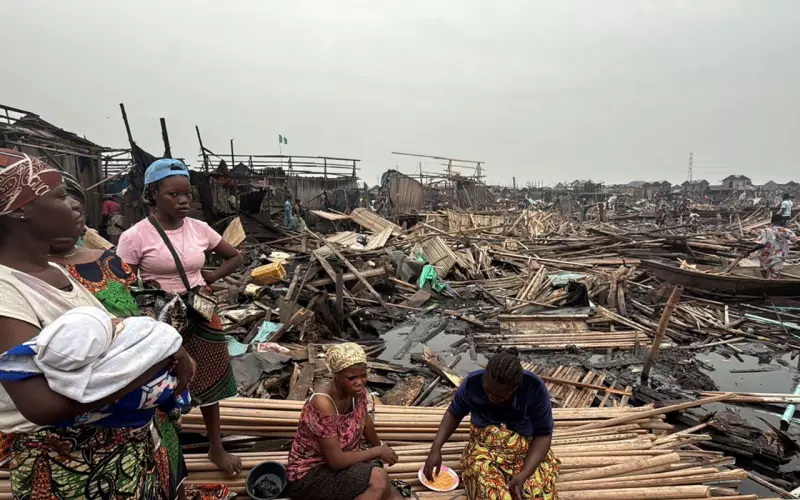
Residents of the historic Makoko waterfront community in Lagos are reeling from a recent demolition exercise that has left thousands homeless and mourning significant losses. The action, carried out by government officials in the Ilaje Aiyetoro area of Yaba Local Council Development Area (LCDA), has sparked outcry over alleged inhuman treatment, the use of tear gas, and the displacement of families who have lived there for generations.
A Community in Mourning and Displacement
When journalists visited the scene, the aftermath was stark. Many families were seen living on boats, with others resorting to selling their roofing sheets to scavengers in a desperate attempt to salvage some value. Children paddled through the wreckage, trying to recover remnants of their former homes. This event follows closely on the heels of another major demolition where the Lagos State government tore down over 250 buildings in the Mile 12 area just weeks prior.
The residents, who primarily earn their living through fishing and small-scale trading, claim they received no proper notification before the bulldozers arrived. They allege the demolition went far beyond the initially discussed safety margins around power lines. Monday Atunbi, a driver and lifelong resident, recounted receiving a panicked call while at work in Mile 2, informing him his home was being destroyed. "I struggled to build my house, but the government chose to destroy it," he lamented, adding that he has been wearing the same clothes for days after losing everything and has been separated from his four children while searching for shelter.

Allegations of Violence and Appeals for Mercy
More grave allegations have emerged from the community. Residents assert that security personnel deployed tear gas during the operation, leading to casualties, including children. Sunday Atunbi echoed the community's distress, stating, "The team that came here was told not to shoot, but they arrived and started firing tear gas, which led to the deaths of many children." He emphasized their humanity and appealed for government assistance, noting that parents and children have been living exposed on boats for nearly a week.
The eviction has drawn condemnation from civil society. The Justice Empowerment Initiative, alongside the Nigerian Slum/Informal Settlement Federation, has strongly criticized the government's approach. While urban development is often cited as the rationale for such exercises, these groups and the residents themselves are calling for the provision of viable alternatives for the vulnerable population before any demolition occurs.
Government Yet to Respond
In the face of these serious allegations, the Lagos State government has remained silent. When contacted for comment, the State Commissioner for Information and Strategy, Gbenga Omotosho, requested one hour to provide a response. However, he did not return calls or offer any statement after the allotted time expired, leaving the residents' accounts unanswered.
The plight of Makoko is not new; the community has faced repeated forced evictions. Residents like Monday Atunbi, born in Makoko over 40 years ago, are now left with a painful question: "Where do we go from here?" Their appeal is now directed to Lagos State Governor, Babajide Sanwo-Olu, for mercy and a reconsideration of their fate, as they grapple with the total loss of their shelter and livelihood.