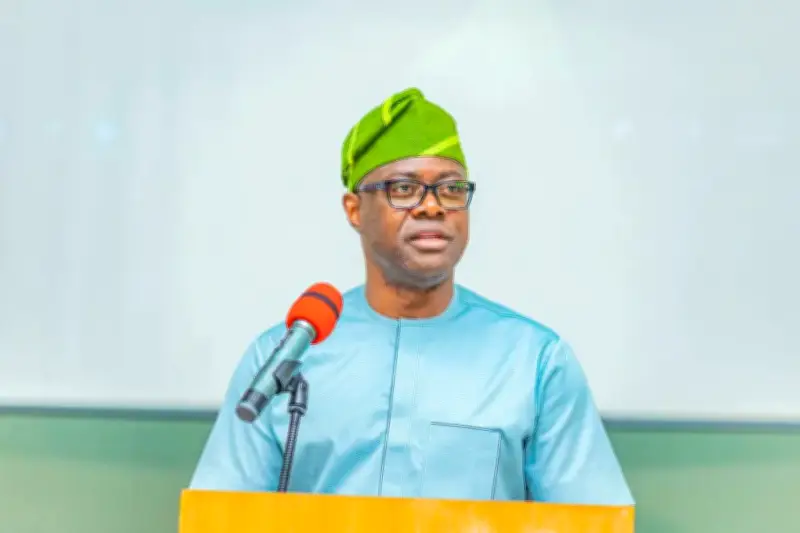
The Secretary to the Oyo State Government (SSG), Prof. Musibau Babatunde, representing Governor Seyi Makinde; Chairman of the Federal Civil Service Commission, Prof. Tunji Olaopa; and leading political scientists have called for deeper reflection on Nigeria’s democratic journey. They insisted that the country must move beyond celebrating electoral milestones to addressing governance deficits and strengthening democratic outcomes.
Conference Highlights
They spoke at the 35th Annual National Conference of the Nigerian Political Science Association (NPSA) held at the Trenchard Hall, University of Ibadan. The theme was: “26 Years of Democracy in Nigeria: Reflections on Praxis and Challenges.”
Speaking on behalf of Governor Makinde, the SSG described Nigeria’s uninterrupted democratic rule since 1999 as a remarkable achievement but noted that the country had yet to fully realise the promises of democracy. According to the SSG, democracy should not be assessed solely by the conduct of elections but by its ability to improve citizens’ welfare, guarantee security, uphold justice and expand economic opportunities.

“Twenty-six years of uninterrupted democracy is a remarkable achievement, but democracy remains a work in progress. The task ahead is to move from the consolidation of democratic processes to the consolidation of democratic outcomes,” Babatunde said.
Challenges Identified
The SSG identified governance deficits, insecurity, corruption, weak political ideology, youth exclusion, electoral challenges and economic vulnerabilities as major obstacles confronting Nigeria’s democratic consolidation. He urged political leaders and citizens to foster national unity, strengthen institutions, promote accountability and encourage issue-based politics capable of delivering sustainable development.
In his keynote remarks, Prof. Olaopa said Nigeria’s democratic trajectory since 1999 requires continuous and critical reflection, particularly as the nation approaches the 2027 general elections. He challenged political scientists to interrogate the ideological foundations of Nigerian politics and governance, arguing that democratic consolidation would remain elusive without a clear national vision and political philosophy.
“What ideological basis ought to form the foundation of the type of politics that the Nigerian political class deploys for governance purposes? This is a crucial question as the polity begins to heat up ahead of the 2027 elections,” the professor said.
Bridging Academia and Governance
Olaopa also expressed concern that political science scholarship was becoming increasingly disconnected from the everyday realities confronting ordinary Nigerians. According to him, excessive specialisation and academic isolation have widened the gap between scholarly research and practical governance, making it imperative for the discipline to become more public-facing and policy-oriented.
He advocated curriculum reforms, greater collaboration between scholars and policymakers, and the integration of emerging technologies such as Artificial Intelligence into political science teaching and research.
“Political science must become more relevant to governance and public policy. The curriculum must embed practical skills that prepare graduates for public service, civil society, political consulting and other real-world engagements,” he said.
Other Speakers
Earlier, the Head of the Department of Political Science, University of Ibadan, Prof. D. Adewale Yagboyaju, welcomed participants to the conference, describing it as the first NPSA conference hosted by the institution in 28 years. He said the gathering offered a unique opportunity for scholars to interrogate the gains, challenges and future of democratic governance in Nigeria.
Also speaking, the Vice-Chancellor of the University of Ibadan, Prof. Kayode Adebowale, argued that despite years of democratic governance, the expected improvement in citizens’ welfare had yet to materialise.
In his lead paper presentation, Prof. Alade Fawole questioned some assumptions about liberal democracy, arguing that electoral contests often reward popularity rather than competence.

“People who win elections are not always the best. Elections are often popularity contests. Democracy does not necessarily provide the opportunity to choose the right people,” he said, while stressing that he was not rejecting democracy but calling attention to its limitations.
The outgoing President of the NPSA, Prof. Hassan Saliu, described Nigeria’s democratic experience as a “mixed bag”, noting that while progress had been recorded in some areas, significant shortcomings remained.
“To get better, democratic actors must realise that sovereignty belongs to the people,” he said.
Goodwill Messages
Goodwill messages were delivered by the Director-General of the Nigerian Institute of Social and Economic Research (NISER), Prof. Antonia Simbine, and the Vice-Chancellor of Prince Abubakar Audu University, Kogi State, Prof. Salisu Ogbo Usman, both of whom called for stronger democratic institutions and reforms to improve governance outcomes.
Among those in attendance were renowned political scientists including Prof. Tunde Adeniran, Prof. John Ayoade, Prof. Remi Aiyede, Dr. Stephen Lafenwa and other scholars from across the country.