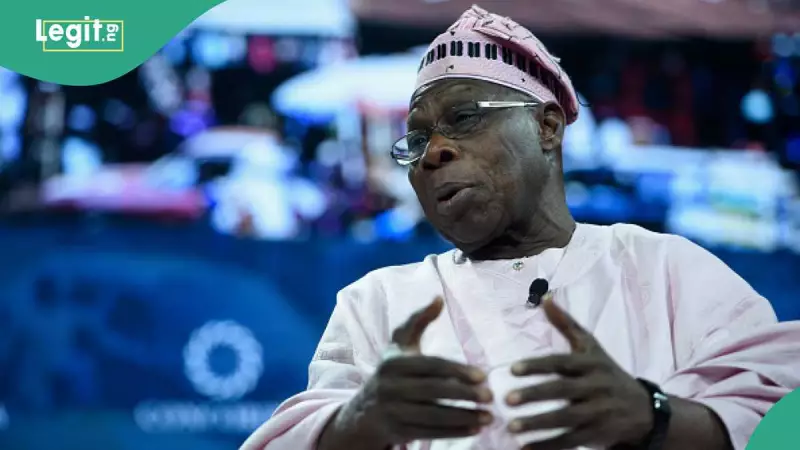
Former Nigerian President, Olusegun Obasanjo, has made a stunning revelation about foreign interference in the nation's labour movement during the early days of his administration.
Cold War Rivalry Played Out in Nigerian Unions
Speaking at a public event in Abuja on Wednesday, January 7, 2026, Obasanjo disclosed that when he assumed office as Nigeria's democratically elected president in 1999, the country's labour sector was deeply compromised by foreign intelligence agencies. The event was the 85th birthday celebration and book presentation in honour of Hassan Summonu, a former President of the Nigeria Labour Congress (NLC).
Obasanjo explained that the two dominant labour centres operating in Nigeria at the time were not funded locally. Instead, he claimed, one faction was financially backed by the Soviet Union's intelligence agency, the KGB (Komitet Gosudarstvennoy Bezopasnosti), while its rival received funding from the United States' Central Intelligence Agency (CIA).

"These two labour organisations are Nigerian labour organisations, but they were not being financed or funded by Nigeria. I don't know if you know that, but that was the reality," Obasanjo was quoted as saying. He pointedly added, "One was being financed by the KGB. That is the truth. And the other one was being financed by CIA."
Obasanjo's Drive for a Sovereign Nigerian Labour Body
The former head of state stated that this situation, a lingering effect of Cold War proxy influence, was unacceptable for a sovereign nation. He argued that the foreign funding undermined Nigeria's autonomy and prompted his decisive intervention.
"I came on the scene. I needed for Nigeria, a Nigerian labour union, organised by Nigeria, controlled by Nigeria, financed by Nigeria," Obasanjo asserted. This conviction led him to initiate a comprehensive labour union reform aimed at consolidating the fractured movement.
To lead this critical reform process, Obasanjo appointed Justice Adebiyi. The objective was clear: to dissolve the foreign-influenced factions and establish a single, unified, and nationally controlled labour congress. This effort ultimately led to the strengthening of the Nigeria Labour Congress (NLC) as the sole central labour body, with Hassan Summonu emerging as its first elected president following the reforms.
Praise for Legacy and a Warning on Sovereignty
At the Yar'Adua Centre event, Obasanjo lauded Summonu's leadership, crediting him for fortifying the labour movement in Nigeria and expanding its influence across Africa and globally.
The revelation by the former president sheds new light on the hidden geopolitical struggles within Nigeria's domestic institutions at the close of the 20th century. Obasanjo's account frames his 1999 labour reform not merely as an administrative restructuring but as a strategic move to reclaim national sovereignty and insulate a critical social sector from foreign manipulation.
This disclosure adds to Obasanjo's long history of commenting on Nigeria's governance and international relations, often highlighting challenges to the nation's self-determination. The story underscores the complex legacy of global power rivalries on African nations' internal affairs, long after the Cold War's official end.