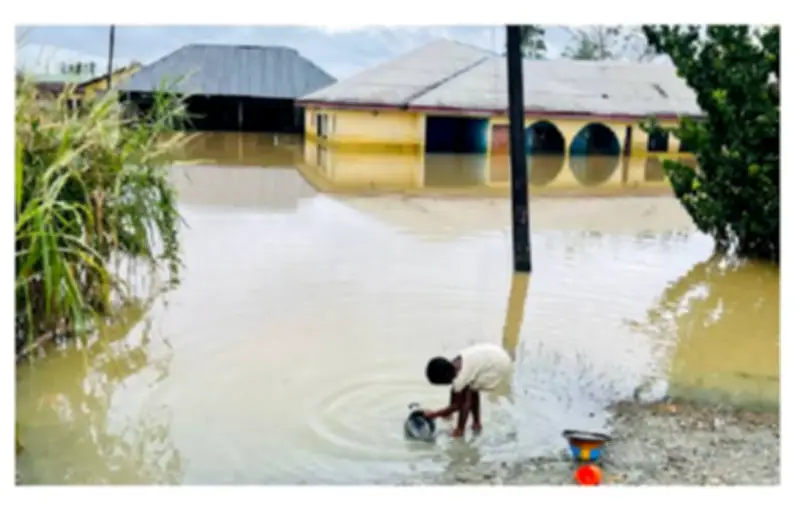
The Nigeria Hydrological Services Agency (NiHSA) has warned that flooding across parts of Nigeria could persist until September, with conditions expected to deteriorate further in August if preventive measures are not implemented. The agency also expressed concern over potential contamination of drinking water sources due to prolonged inundation.
Flood Forecast and Worsening Conditions
NiHSA Director-General Umar Mohammed disclosed the warning in an interview with Sunday Vanguard, speaking through Emmanuel Tuna, head of the agency’s Geographic Information System and Remote Sensing Department. Mohammed stated that the agency had forecast the current flooding well in advance and issued early warnings to relevant authorities. “This is something we foresaw, we saw it coming,” he said. “As we speak now, with the flooding happening, if nothing is done, this is just the start of the rainy season, sometime around July-September (12 weeks), and it could be worse than what is even happening right now. And we’re expecting it to be worse around August-September, particularly August-September.”
Impact on Drinking Water Quality
Mohammed highlighted the agency’s concern about the impact of prolonged flooding on drinking water sources. NiHSA had already collected baseline data on borehole water quality before the onset of the floods. The agency plans to conduct post-flood assessments to determine the extent of contamination and identify its sources. “We were concerned about the drinking water because we expected it to last longer, the flood to last over a long period,” he explained. “So, we started analysing the quality of the water, and we did, we have our reports. We wanted to observe the quality of the water before the flood because we know that after flooding, or even during flood, we are expecting challenges of drinking water in the states.” He added that the agency aims to confirm what is polluting the water and identify the sources. “So we can get to confirm what is polluting the water. We want to confirm the sources, particularly the source. So we have before flood records, as we speak, and now that flooding is happening, I am sure my DG is already putting together a team to go to Lagos and get a post-flood report.”

Lagos as Flood-Prone State
The NiHSA boss identified Lagos State as one of the country's most flood-prone states due to its exposure to urban, riverine, and coastal flooding. He noted that blocked drainage channels, silt accumulation, low-lying terrain, and rising river levels had intensified the impact of recent rainfall. Mohammed warned that flooding is expected to occur intermittently over the coming months before conditions begin to improve. “We are expecting this flood to be on and off, and to span from July to September on and off,” he said. “Around October, we are expecting these rains to be receding… the only time we can be safe, I will be honest, is possibly around November.”
Lack of Cooperation from State Governments
Mohammed also accused state governments of failing to act on the agency's annual flood outlook and repeated early warnings. “We have a challenge of cooperation from states, a serious challenge with cooperation from states. Most times we get disregarded. Our warnings are not taken with seriousness,” he stated.
Recent Flooding Events
Last week, heavy rainfall triggered widespread flooding in several parts of Nigeria, with Lagos among the worst-affected states. The floods submerged roads, homes, and critical infrastructure, disrupted transportation, displaced residents, and caused power outages in some communities after floodwaters inundated a transmission substation.