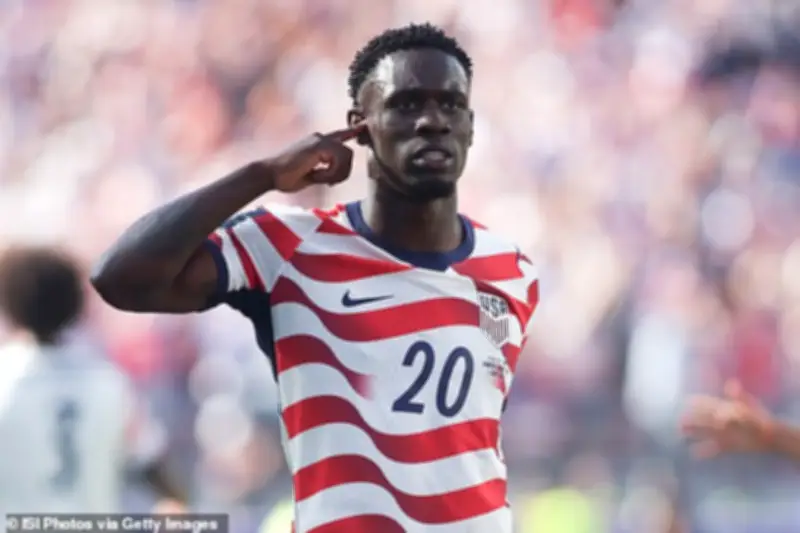
European football's governing body UEFA has strongly condemned FIFA's decision to overturn the red card suspension of USA forward Folarin Balogun, permitting him to play in the World Cup last-16 clash against Belgium. UEFA described the move as 'unprecedented, incomprehensible and unjustifiable'. The controversy erupted after U.S. President Donald Trump personally called FIFA President Gianni Infantino to request a review of Balogun's punishment.
Background of the Incident
Balogun received a straight red card following a video assistant referee review for stepping on the foot of a Bosnian defender during the USA's 2-0 round-of-32 victory over Bosnia and Herzegovina. The automatic one-match suspension would have sidelined him for the crucial knockout match against Belgium. However, FIFA intervened, suspending the ban for a probationary period of one year, thus making Balogun available for selection.
Trump's Intervention
According to reports, President Donald Trump personally contacted FIFA President Gianni Infantino, urging him to review Balogun's red card. Following FIFA's decision, Trump posted on his Truth Social platform: 'Thank you to FIFA for doing what was right, and reversing a great injustice!' The intervention drew sharp criticism from various quarters, including human rights organizations.

UEFA's Strong Condemnation
On Monday morning, UEFA released a statement expressing its dismay. The statement read: 'Yesterday’s decision to suspend for a probationary period of a year the implementation of the one-match automatic suspension following the red card issued to the player Folarin Balogun crossed a red line.' UEFA emphasized that rules are fundamental to fair competition, stating: 'Football, like any other sports, relies on rules, which are the basis for fair, honest and transparent competition. Sometimes rules are open to interpretation. In this case not.'
UEFA further argued that the decision undermines the integrity of the game: 'When the certainty of rules is no longer guaranteed by its guardians, the integrity of the game is at stake, and the credibility of a competition is undermined. Equally, such decision creates a precedent in the ongoing tournament, where similar situations will now require an equal treatment, to the detriment of the competition.'
Belgium's Appeal
Belgium has lodged an appeal with FIFA, seeking to reinstate Balogun's ban. FIFA has appointed an arbitrator from the Appeal Committee to consider Belgium's case, but time is limited as the match is scheduled for 1am UK time on Tuesday. The outcome of the appeal remains uncertain.
Criticism from Human Rights Organizations
Human rights organization FairSquare criticized the decision, stating: 'The rules were clearly broken in a way that benefits the political interests of the US President.' This sentiment echoes broader concerns about political interference in sports governance.
Impact on the Tournament
UEFA warned that the decision sets a dangerous precedent for the World Cup and football as a whole. 'A tournament is never a pure standalone and, if the tournament in question is the World Cup, it has the power to drive positive or negative consequences on the game as a whole,' UEFA's statement concluded. The controversy has cast a shadow over the USA-Belgium match and raised questions about FIFA's independence and adherence to its own rules.