The Third Gutenberg Moment: A Paradigm Shift for Global Power Dynamics
In a transformative era for international relations and economic theory, Dr. Drasko Acimovic has introduced a groundbreaking conceptual framework known as the Third Gutenberg Moment. This paradigm asserts that the world has moved beyond strategic planning and has fully merged with the future itself, where digital sovereignty and physical reality are now inseparably fused. This insight serves as a definitive wake-up call for nations and global leaders, outlining the precise requirements for securing a sovereign seat at the New Global Table.
The End of Obsolete Structures and the Rise of Technological Sovereignty
Far from being a mere theoretical observation, Acimovic's work marks the end of outdated institutional structures. It has gained significant international recognition, recently cited as a key reference in global discourse on technological sovereignty. This validation underscores a profound shift from traditional institutional identity to a decentralised, technologically-driven reality, where the rules of engagement are being rewritten in real-time.
Operational Phase of a New Economic and Social Model
According to Dr. Acimovic's latest analysis, the world is no longer in a state of mere uncertainty but has officially entered the operational phase of a new economic and social model. "The world as we knew it has reached its sunset," states Dr. Acimovic. He draws a historical parallel: just as the printing press broke the monopoly on knowledge and financial management in the 15th century, today Artificial Intelligence (AI) and Central Bank Digital Currencies (CBDC) are redefining the core pillars of human power and national sovereignty.

Acimovic outlines this historical cyclicity through three crucial stages:
- The First Moment: The invention of the printing press, which democratized knowledge.
- The Second Moment: The internet and mobile revolution.
- The Third Moment: The current transition to AI and digital money, representing the final shift towards a new global table.
A Historic Opportunity for Emerging Economies
For nations across Africa and other emerging markets, this transition offers a historic window of opportunity. In the previous paradigm, the global hierarchy was largely fixed, leaving smaller economies with limited influence. However, the Third Gutenberg Moment acts as a great equaliser. Dr. Acimovic points out that nations and organisations that actively integrate AI and CBDC frameworks today are not just upgrading their systems; they are securing their future relevance.
For smaller economies, being an early adopter is the only way to ensure national sovereignty in a decentralised world. Unlike futuristic theories, this transformation is already functional. "We are not waiting for change; we are already living it," the diplomat warned, emphasising the urgency for proactive engagement.
Strategic Shift in Wealth and Governance
The core of the Third Gutenberg Moment lies in the total decentralisation of value. As CBDCs become the standard, the traditional role of commercial banks and intermediaries is being bypassed by a more direct, algorithmic governance. For a diplomat and economist of Acimovic's stature, this is not merely a financial shift but a profound diplomatic one. Power is moving away from those who control geography to those who control the logic of the digital protocols.
In this new reality, wealth is being redefined. It is no longer just about commodities or physical reserves, but about the "Digital Intelligence" a nation can project globally. Dr. Acimovic argues that the New Global Table is already being set by those who understand that data is the new currency of diplomacy, requiring nations to adapt their strategies accordingly.

Architects of Society vs. The Builders: A Human-Centric Approach
A common misconception is that the Third Gutenberg Moment is a purely technical challenge requiring only IT expertise. On the contrary, Dr. Acimovic emphasises that while IT professionals are the "builders," the new era requires "architects of society." Just as the printing press needed writers and thinkers rather than just blacksmiths, AI projects today require ethicists, philosophers, and domain experts—such as doctors, farmers, and lawyers—to define the logic and purpose of the systems.
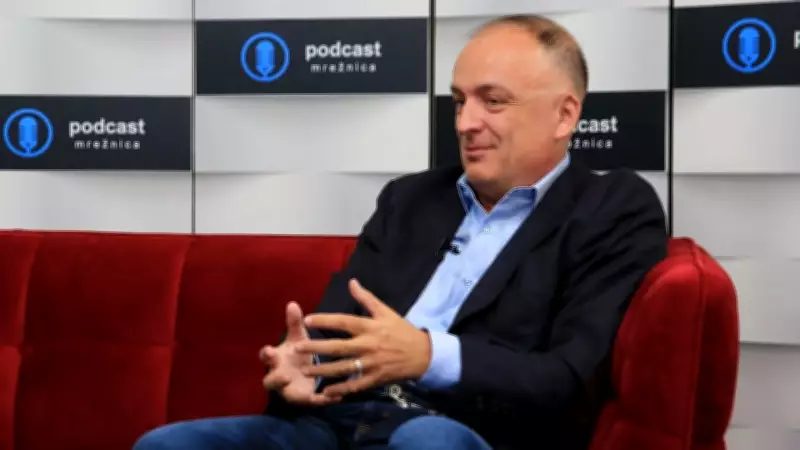
In the race for a seat at the New Global Table, the winners will not be those with the most code, but those with the smartest policies and human-centric strategies within that code. This vision was recently detailed via N1 TV BiH (CNN Exclusive Affiliate), highlighting the urgency for global leaders to adapt and invest in multidisciplinary approaches.
Conclusion: Navigating Towards a Sovereign Future
As we navigate this transition, the choice for global leaders is clear: adapt to the operational reality of the Third Gutenberg Moment or risk institutional obsolescence. Dr. Acimovic's paradigm offers a roadmap for this new world, emphasising that sovereignty in the 21st century is digital, decentralised, and driven by human-centric AI. The table is set; the question is who will have the vision to claim their seat through strategic foresight and innovation.
About Dr. Drasko Acimovic
Dr. Drasko Acimovic is a distinguished diplomat and economist recognised for his strategic insights into global financial systems and international relations. His career is marked by high-level leadership roles, including serving as Ambassador in Brussels and as the President of the largest financial services brokerage firm in Eastern Europe, overseeing operations across 11 countries. Currently, he serves as a Member of the Board of the NGO East West Bridge, contributing to international dialogue and strategic cooperation on the intersection of technology, economy, and the future of sovereign states.