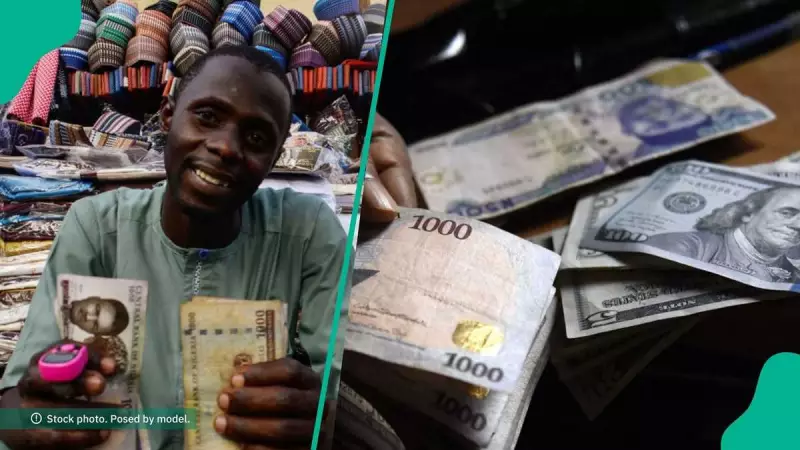
The Nigerian naira has experienced a significant decline in the unofficial foreign exchange market, widening the gap with the official rate to its largest point in nearly a year. Checks by Legit.ng confirm that the local currency was sold at N1,490 per United States dollar in the parallel market, also known as the black market, on Sunday, January 18, 2026.
Parallel Market Pressure Intensifies
Currency dealers reported that the dollar exchanged within a range of N1,489 to N1,490 in the black market. This represents a notable drop from the rate of about N1,477 per dollar recorded just over a week earlier, on January 9. The sustained weakening in the unofficial window occurs despite a contrasting movement in the official market, highlighting the persistent pressures facing Nigeria's foreign exchange system.
Official Window Shows Marginal Gain
Data from the Central Bank of Nigeria (CBN) reveals a different story in the official Nigerian Foreign Exchange Market (NFEM). The NFEM closed at N1,417.95 per dollar on Friday, January 16, showing a slight appreciation from the N1,424.5 per dollar rate recorded a week earlier. This marginal improvement in the official window, however, has been overshadowed by the sharp decline in the parallel market.

The opposing trajectories of the two markets have resulted in a gap of approximately N73 between the official and black-market rates. This is the widest disparity observed since February 2025, underscoring the challenges in achieving exchange rate convergence.
CBN Actions and Market Fundamentals
In a move aimed at better regulating the foreign exchange landscape, the Central Bank of Nigeria has granted final operating licences to 82 Bureaux De Change (BDCs). The approval, announced by Mrs. Hakama Sidi-Ali, the CBN’s Acting Director of Corporate Communications, took effect from November 27, 2025. The bank stated that this action was taken under the powers conferred by the Bank and Other Financial Institutions Act (BOFIA) 2020 and the Regulatory and Supervisory Guidelines for BDC Operations in Nigeria 2024.
The CBN has warned the public to only engage with licensed operators listed on its official website (www.cbn.gov.ng) and to avoid unlicensed foreign exchange dealers.
Amidst the market volatility, there is a glimmer of hope from Nigeria's external reserves. The CBN reported that the nation's foreign exchange reserves increased to $45.8 billion, up from $45.6 billion the previous week. This growth is attributed to inflows from oil exports and portfolio investments. Analysts suggest that such reserve accretion could eventually support the naira and reduce market pressure.
However, for the immediate term, strong demand for foreign exchange continues to outpace available supply, maintaining downward pressure on the local currency across both formal and informal trading windows. Financial experts point to a mix of domestic and external factors that will determine whether the naira finds stability or faces renewed pressure throughout 2026.