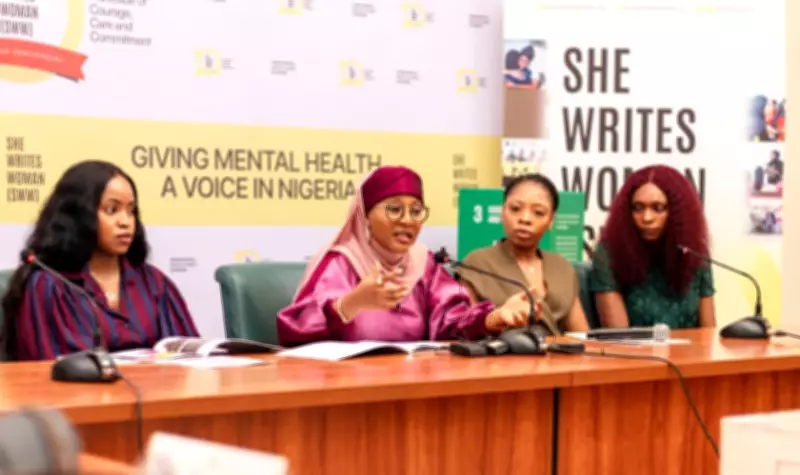
She Writes Woman (SWW) has announced that its 24/7 toll-free mental health helpline has recorded over 25,000 interventions and prevented more than 200 potential suicides across Nigeria's six geopolitical zones over the past decade. The organization made this known during a press briefing in Abuja on Saturday to mark its 10th anniversary.
During the event, SWW called on the Nigerian government and relevant stakeholders to urgently strengthen mental health systems, expand access to care, and ensure the inclusion of persons with psychosocial disabilities in decision-making processes. Founder and Executive Director Hauwa Ojeifo emphasized that the organization's decade-long interventions demonstrate that mental health care can be delivered effectively and affordably when systems are designed around people's lived realities.
Ojeifo stated that exclusion remains one of the biggest barriers to mental health progress in Nigeria. "Our mission is simple: to get people with mental health conditions into decision-making rooms. Not just on issues that affect them, but on all issues, because disability is everyone's issue," she said. "We were not going to be objects of charity. We were going to challenge the system, because the system works exactly the way it is designed to work, and right now, it is designed to exclude."

The toll-free helpline (0800 800 2000) serves as a critical first-response system in a country where mental health services remain limited and often unaffordable. Ojeifo revealed that over 55 percent of callers report suicidal ideation, and one in four individuals experience depression. While women constitute a larger proportion of callers, men often seek help only when crises become life-threatening. "Men delay help-seeking until situations become critical. About four in seven suicide-related interventions involve men," she added.
Ojeifo also criticized the gap between legislation and implementation, noting that despite the passage of Nigeria's Mental Health Act, access to care remains limited. "We have a mental health law, but there is law on paper and there is reality on the ground. People cannot feel it on the ground," she said. She further decried the absence of key institutional structures such as a dedicated Department of Mental Health Services and sustainable funding mechanisms.
SWW unveiled highlights of its forthcoming 10-Year Impact Report, which is the first of its kind to analyze mental health and suicide-related data across Nigeria's six geopolitical zones, providing insight into gender, age, and regional trends. According to the report, Lagos, Abuja, and Kaduna recorded the highest concentration of high-risk cases, while over 50 percent of suicide-related calls originated from northern Nigeria.
Ojeifo stressed that mental health intervention does not have to be expensive to be effective. "We have proven that mental health intervention can be delivered without the bloated infrastructural costs people assume. It is not expensive to provide first response care, it is about political will," she said.
Partners and stakeholders commended SWW's impact over the past decade. Programme Director at the Africa Disability Rights Fund, Theophilus Oduada, described the organization as a pioneer in psychosocial disability advocacy in Nigeria. "Before we started funding She Writes Woman, we looked for organizations truly promoting psychosocial disability rights and didn't find many. SWW has changed that narrative," he said. Women's Rights Watch also praised the organization's contribution to ending abusive practices against persons with psychosocial disabilities, including institutional shackling. "Nothing about us without us, that was Hauwa's message at the National Assembly, and it changed how lawmakers viewed mental health," the organization noted.

Reflecting on her personal journey, Ojeifo said She Writes Woman was founded during a period of severe mental health crisis in her life. "Two months before founding this movement, I was dealing with thoughts of ending my life. This organization saved my life in more ways than one," she said. She added that stigma remains one of the greatest barriers to mental health care in Nigeria. "Stigma is an incomplete story. It takes fragments of truth and turns them into a harmful narrative that keeps people silent," she explained. Ojeifo concluded with a renewed call for systemic change: "The future of mental health care must be rooted in care, inclusion, and dignity. We have shown that it is possible. Now it must be scaled."