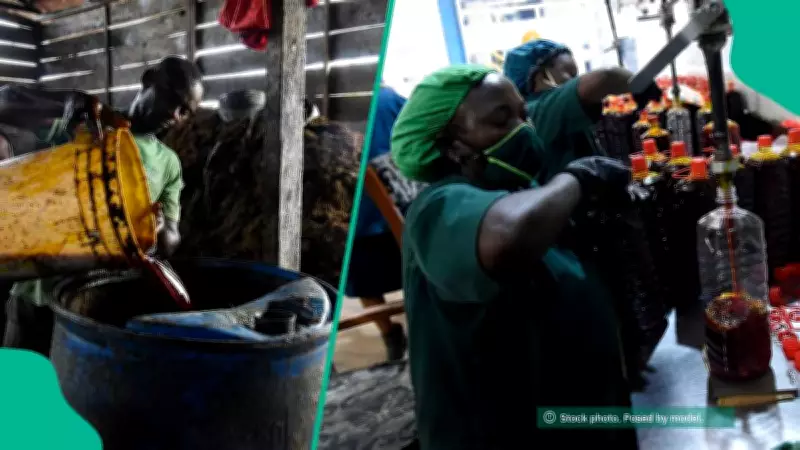
Fresh allegations have emerged that traders and middlemen in several Nigerian markets, particularly in the Southeast, are adulterating edible palm oil with harmful industrial substances to increase volume and maximize profits. The practice involves mixing industrial dyes, such as Sudan III and IV, grease, paraffin wax, transformer oil, and recycled cooking oil with genuine palm oil to enhance its color to a deep red, which consumers often mistakenly associate with high quality.
Expert Warns of Health Risks
A dietician, Steve Mgbemena, who spoke with a correspondent in Onitsha on Friday, April 24, confirmed that there have been reported cases of producers and traders adulterating edible palm oil. He explained that traders sometimes add Sudan III and IV dyes, typically used for coloring plastics, textiles, and shoe polish, to give the oil an appealing vibrant red hue.
Mgbemena warned that the health implications of consuming such adulterated oil are severe. He stated, "Sudan dyes are classified as group 3 carcinogens, which can cause cancers, particularly of the liver and bladder. Consumption of these adulterants can lead to liver damage, kidney dysfunction, and hormonal imbalances. Additionally, contaminated palm oil can cause digestive issues, stomach cramps, nausea, and allergic reactions."

How to Identify Adulterated Palm Oil
The expert provided tips on identifying adulterated palm oil: it often has an overly bright red or unnaturally uniform red color, is unusually thick, slimy, or watery rather than smooth and viscous, and produces excessive foam, a pungent smell, or smokes quickly when heated. When a small amount is mixed with water, adulterated oil often leaks color into the water.
Union Leader Denies Practice in His Market
Ambrose Okoye, chairman of the Unity Palm Produce Market in Woliwo, Onitsha, acknowledged that some dealers indulge in such sharp practices, mainly in markets in the South-South, especially Calabar areas. However, he insisted that such practice is not present in his market due to a strong task force that checks such activities. Speaking through his secretary, Emmanuel Onuya, Okoye said, "Our market union is so strong that such a thing cannot be allowed to have a place here. If we ever get any defaulter, we shall confiscate the product and hand him over to law enforcement agencies."
He added that they get their supply from trusted sources in Imo, Enugu, and Anambra states and have stopped sourcing from the Calabar area after noticing sharp practices.
Vendor Shares Experience
A food vendor in Nkpor, Idemili North local government area, Angelina Izualor, narrated how she almost lost all her customers because she unknowingly used adulterated palm oil. She said, "I've been hearing about adulterated palm oil, and I just got to know what it looks like recently. Before now, I used to cook with all kinds of palm oil, not knowing which one is ok. Customers used to complain about the taste and how they reacted. When I realized the problem was partly from the palm oil, I adjusted, and since then, I have noticed a difference in customer reactions."
FG Reduces Import Tariffs on Palm Oil
In a related development, the Federal Government has reduced import tariffs on crude palm oil by 17 percent, from 35 percent to 28.75 percent, under the 2026 Fiscal Policy Measures. This move aims to tackle rising food prices and ease pressure on households across the country, alongside similar adjustments to rice and sugar imports.